
 Available in US
Content

Over/Under Is the Second Most Popular Football Market in the UK After Match Result
I once watched a goalless first half between two teams that both averaged over two goals per game, turned to my phone, and placed an under 2.5 in-play bet at 1.40. Both teams scored twice in the second half and I lost. That match taught me something I now consider fundamental: averages are not predictions. The goals market rewards people who understand distributions, not people who read league tables and assume every fixture plays out like the mean.
With over 290 million online bets placed each month in the UK and football dominating the landscape with 1.3 billion pounds in remote gross gambling yield, the over/under market absorbs a colossal share of that volume. It is the market of choice for bettors who do not want to pick a winner but still want skin in the game. That broad appeal also makes it one of the most competitively priced markets available — which means finding value requires more than gut feeling.

Understanding the 2.5 Line and Its Variants
The 2.5 goals line is the most traded in football, and the reason is mathematical. Across major European leagues, the average goals per match sits between 2.5 and 2.8. That means the 2.5 line sits right at the decision boundary — roughly half of all matches go over and half go under, depending on the league and the specific fixture. This is exactly where the bookmaker wants you: on a knife edge, paying a margin for the privilege of picking a side.
Over 2.5 means three or more goals in the match. Under 2.5 means two or fewer. There is no push — the half-goal eliminates the possibility of a dead heat. That clarity is part of the market’s appeal, but it can also create a false sense of precision. A price of 1.85 on over 2.5 implies roughly 54% probability. If your analysis says the true probability is 56%, you have a tiny edge that will take hundreds of bets to manifest. If your analysis says 60%, you have a meaningful edge. The discipline is in the honesty of your probability estimate.
Lower lines — over 0.5, over 1.5 — are priced at very short odds because most football matches produce at least one or two goals. Over 0.5 goals in a Premier League match hits around 96% of the time, so the odds sit somewhere around 1.04. There is no practical value there. Over 1.5 lands around 80% of the time, priced at roughly 1.25 to 1.35 depending on the fixture. The value window on these lines is extremely narrow.
Higher lines — over 3.5, over 4.5 — offer bigger prices but lower strike rates. Over 3.5 in the Premier League hits roughly 30-35% of the time. This is where league-specific knowledge starts to pay off. A fixture between two defensively weak sides that both press high might genuinely justify over 3.5 at 2.50, while the same price for a match involving a side that plays low-block defensive football offers no value at all.
Asian Totals and Quarter Lines
If standard over/under markets are the motorway, Asian totals are the back roads — less traffic, more nuance, and occasionally a shortcut the crowd has not found.
Asian total lines use quarter-goal increments: 2.25, 2.75, 3.25 and so on. A line of 2.25 splits your stake evenly between 2.0 and 2.5. If the match produces exactly two goals, you lose half your stake (on the 2.5 portion) and push on the other half (on the 2.0 portion). Three or more goals wins the full bet. One or fewer goals loses everything. The quarter line gives you partial protection against the dead-heat scenario, and that protection has a cost built into the odds.
I find Asian totals most useful when my analysis puts the true expected goals right on or very near a standard line. If I estimate a match at 2.6 expected goals, the over 2.5 line is almost a coin flip. Moving to over 2.25 at slightly lower odds gives me partial cover if the match lands on exactly two goals. That insurance has real value in a sport where a single missed penalty or disallowed goal can swing the total from three to two.
Liquidity on Asian total lines is thinner than on standard over/under, which means you may need to shop across multiple operators to find a competitive price. The variance in pricing is also larger — I have seen a 0.15 difference in odds for the same Asian total line across major UK bookmakers. Those margins compound significantly over hundreds of bets.

What Drives Goal Totals: Form, Fixtures, and Context
Every football punter has a story about backing over 2.5 in a match between two high-scoring teams and watching a tedious 0-0 unfold. Fixture context matters more than season-long averages, and the bettors who consistently find value in goals markets are the ones who dig into the why behind the numbers.
Fixture importance is the single most underrated factor. A dead rubber on the final day of the season between two mid-table sides with nothing to play for often produces open, careless football — more goals, more value on overs. A match with relegation or promotion implications produces tighter, more cautious play — fewer goals, more value on unders. I track fixture stakes as carefully as I track expected goals data, because a team’s motivation to avoid conceding is not captured by any statistical model.

Weather and pitch conditions are dismissed by most bettors as noise, but they have a measurable effect on goal totals in English football. Wet, heavy pitches slow passing play and make defending set pieces harder — which tends to produce chaotic, higher-scoring games in the lower leagues but can suppress goals in the Premier League where technical quality is higher. Fixture scheduling also plays a role: midweek matches following a weekend game see increased squad rotation, which disrupts defensive cohesion and tends to push goal totals up by 0.2-0.3 on average in the Championship.
Managerial changes produce the sharpest deviations from baseline. A new manager’s first three matches tend to see elevated goal totals because the team has not yet absorbed the new tactical system. The “new manager bounce” in results is well documented, but the effect on goals is less discussed. I have tracked it across four Championship seasons and found a consistent uptick of 0.4 expected goals per match in the first three games under a new manager.

Common Mistakes When Betting Goals Markets
The mistakes I see most often — and the ones I made myself for longer than I care to admit — tend to cluster around a few patterns.
Anchoring to season averages is the biggest one. A team averaging 3.1 goals per game through their first ten fixtures will regress towards the league mean. Backing overs on their matches at 1.70 because “they are in a high-scoring run” is not analysis — it is chasing noise. Expected goals data will usually show that the underlying chance creation does not support the scoring rate, and the market has already adjusted.
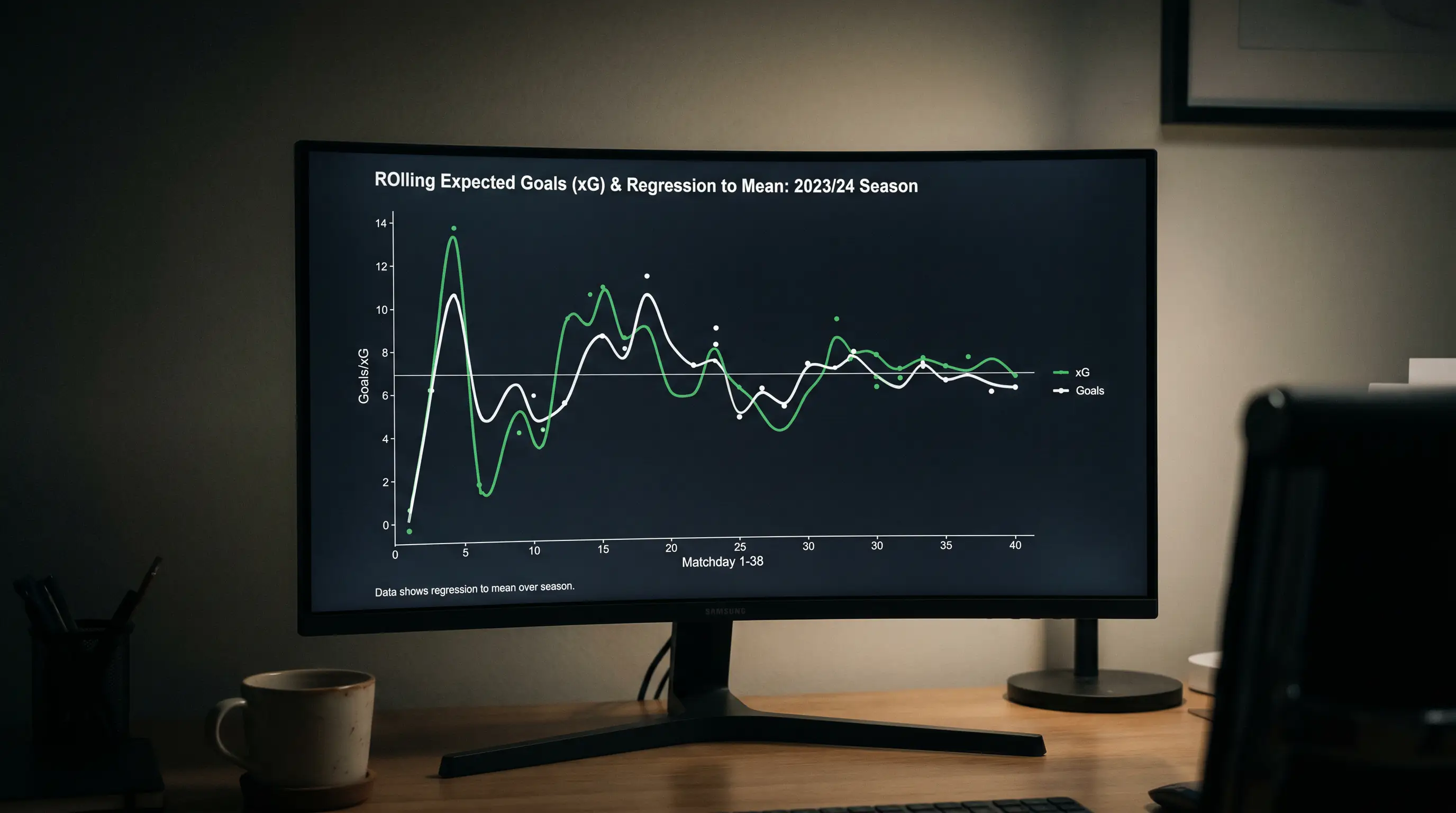
Ignoring the under side is the second. Casual bettors overwhelmingly favour overs because goals are exciting and unders feel like rooting for boredom. This systematic bias means under prices can carry better value in aggregate. In my own records over the past five years, unders have returned a higher ROI than overs in the Premier League, despite a lower strike rate, purely because the prices offered on unders are consistently more generous relative to the true probability.
Adding goals bets to accumulators without adjusting for margin is the third. Each leg of an accumulator compounds the bookmaker’s edge. A four-fold of over 2.5 goals bets, each priced with a 6% margin, produces a cumulative margin above 20%. The market data shows 2.7% of UK adults qualify as problem gamblers on the PGSI scale, and accumulator traps — big promised payouts on high-margin multiples — are a meaningful contributor to losses that spiral beyond entertainment. Keep goals bets as singles or very small doubles, and know your edge before staking. For a wider look at different goals market combinations, the BTTS tips guide covers the overlap with both-teams-to-score bets in detail.

What does over 2.5 goals mean in football betting?
Over 2.5 goals means you are betting that the total number of goals scored in the match by both teams combined will be three or more. If the match finishes with two goals or fewer, the bet loses. The half-goal line eliminates any possibility of a draw or push on the bet.
Are Asian total goals markets better value than standard over/under?
Not inherently, but they offer more precise positioning. Asian quarter lines let you split your stake across two adjacent totals, providing partial insurance when your analysis puts the expected goals right on a standard line. The value depends on the specific price offered — Asian lines can carry tighter margins on some operators and wider margins on others, so comparison shopping is essential.
