
 Available in US
Content
- 6% of All UK Adults Bet on Live Football — Here Is How It Works
- In-Play Markets: What You Can Bet on After Kick-Off
- Timing and Momentum: When to Place a Live Bet
- Cash Out and Partial Cash Out in Live Betting
- Latency, Suspension, and the Risks of Live Betting
- Live vs Pre-Match: Where the Edge Sits
- In-Play Betting Rewards Preparation, Not Reflexes
- FAQ
6% of All UK Adults Bet on Live Football — Here Is How It Works
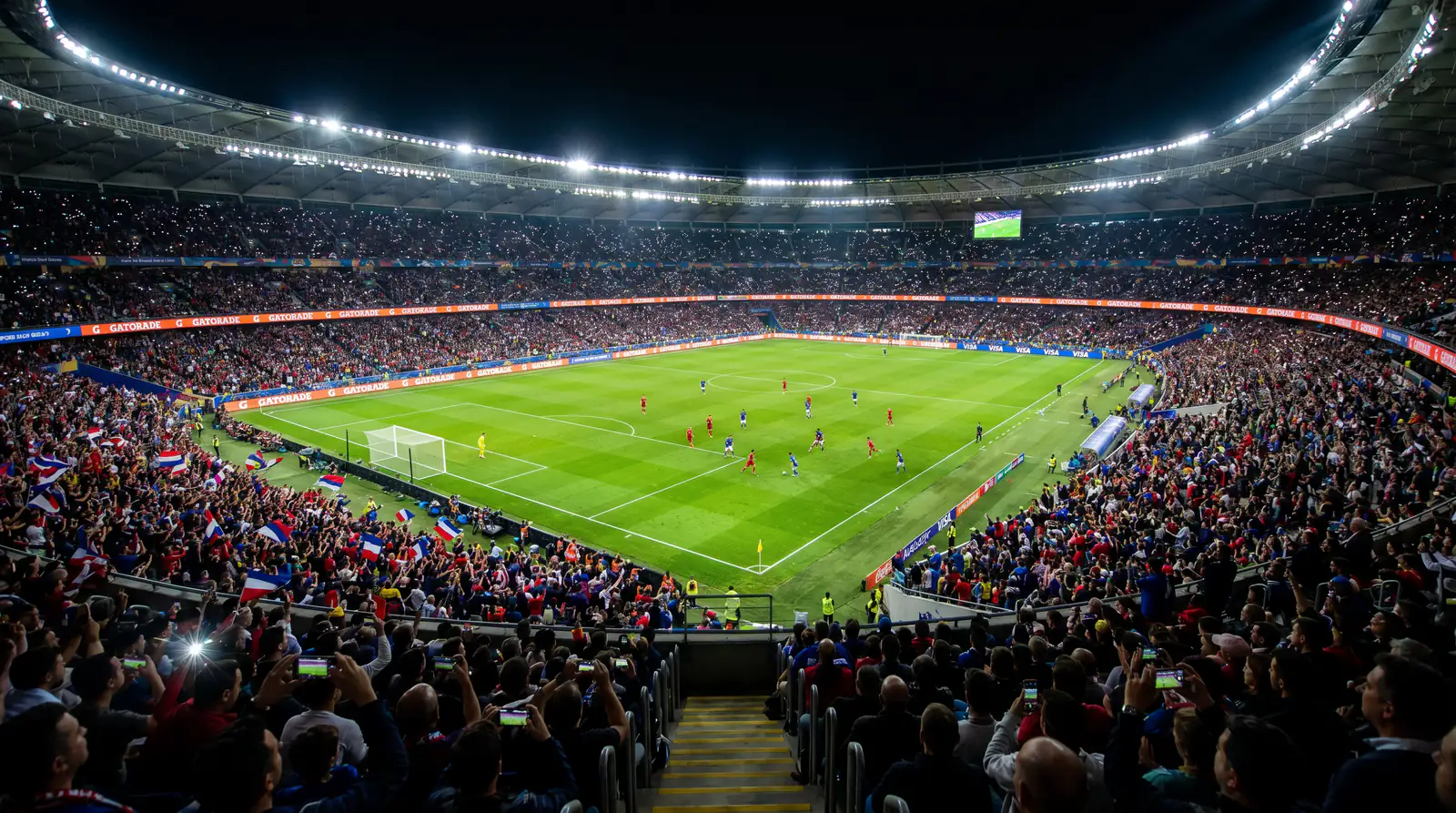
The first live bet I ever placed was on a second-half goal in a Championship match I was watching in a pub. It won, and the dopamine hit was entirely different from a pre-match bet settling an hour after the final whistle. The immediacy, the real-time connection between what was happening on the pitch and the money in my account — it’s easy to see why in-play football betting has become the fastest-growing segment of the UK market.
The numbers back up the feeling. Six percent of all UK adults bet on live football, making it the single most popular live betting activity in the country. Among men, the figure is 9%. That’s millions of people placing bets while the match is underway, reacting to goals, red cards, injuries, and tactical shifts in real time. Fifteen percent of men and 4% of women in the UK bet on sport generally, and a significant chunk of that activity now happens after kick-off rather than before it.
In-play betting is exciting. It’s also faster, riskier, and more psychologically demanding than pre-match betting. The markets move in seconds. The temptation to chase a losing position or double down on a live hunch is stronger than anything you’ll face before a match starts. Over 290 million online bets are placed on real events in the UK every month, and a growing proportion of those are in-play. This guide covers the markets available, the timing that matters, and the specific risks that live betting creates — because understanding those risks is the only way to exploit the opportunities without them exploiting you.
In-Play Markets: What You Can Bet on After Kick-Off
The range of markets available in-play has expanded dramatically over the past five years. When live betting first appeared on UK platforms, you could bet on the match result and maybe the next goal. Now, a major operator covering a Premier League match in-play might offer sixty or seventy markets simultaneously, all updating in real time.
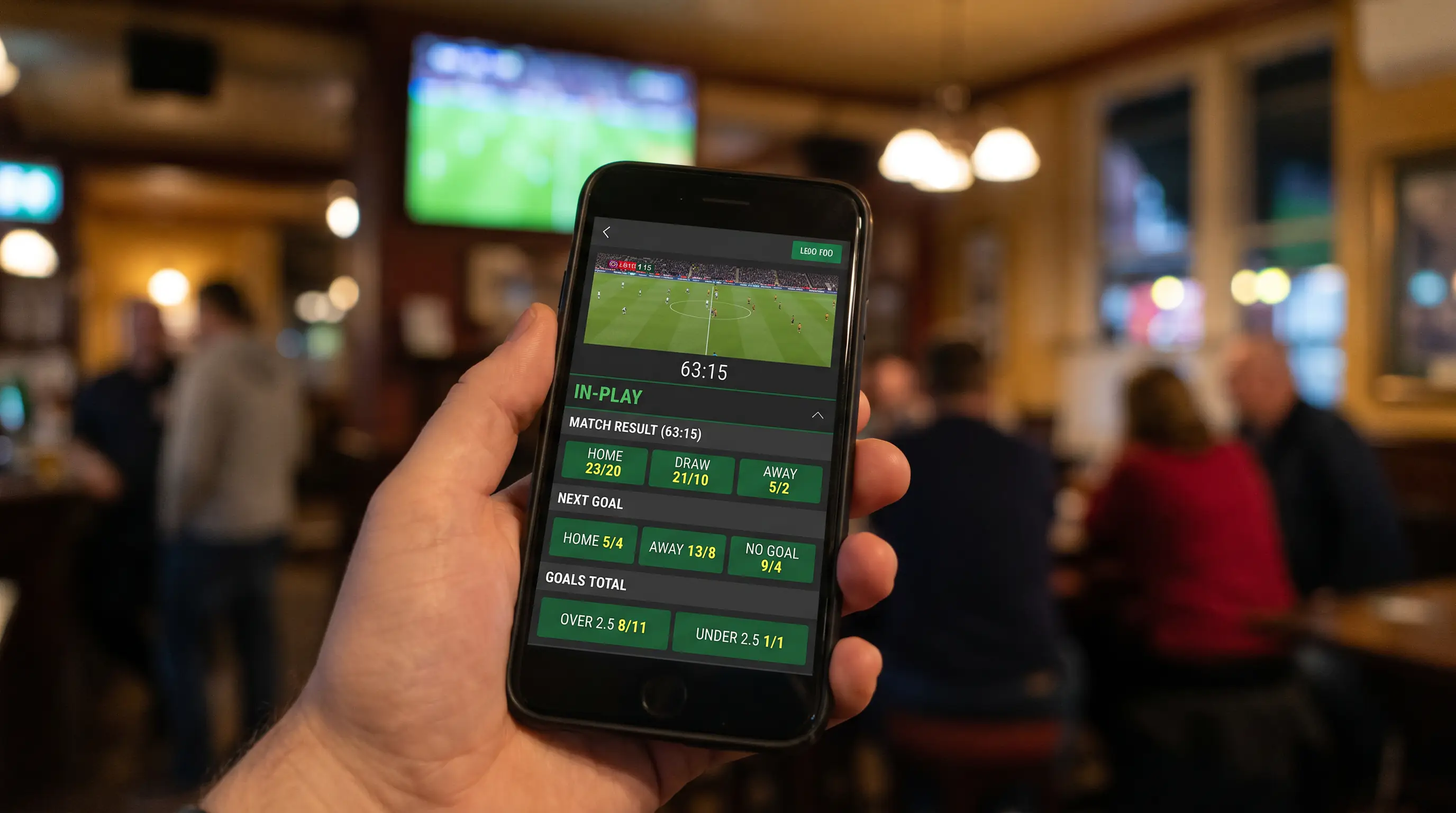
Match result is the foundation. The 1X2 market reprices continuously based on the score, time elapsed, and match dynamics. A team priced at 2.50 pre-match might be 1.40 at half-time if they’re a goal up, or 5.00 if they’re behind. The repricing is algorithmic — the bookmaker’s model calculates new probabilities after every significant event and adjusts the odds accordingly.
Next goal markets are where much of the in-play action concentrates. You can back either team or “no goal” for the next goal scored, with odds that fluctuate based on match state. After a goal, the next goal market typically suspends for 30-60 seconds while the algorithms recalibrate, then reopens at new prices. The speed of suspension and reopening varies between operators, and it matters — the first operator to reopen after a goal can offer prices that don’t yet fully reflect the changed situation.
Goals totals — Over/Under lines for the match or remaining portion of the match — are available in-play and often represent the most analytically accessible live market. If you’ve assessed a match as likely to produce goals based on the pre-match setup, and that assessment is confirmed by what you’re watching (open play, attacking intent from both sides, defensive disorganisation), the live Over market might still offer value if the score is 0-0 at the thirty-minute mark. The price will have shortened from the pre-match level, but the live evidence supporting your view is now stronger than it was before kick-off.
Corners, cards, and player-specific markets add another layer. You can bet on the next corner, the total corners in the match, the next booking, and — on some platforms — even the next throw-in or goal kick. These micro-markets are entertaining but carry wide margins and are almost impossible to analyse with any rigour. I stick to match result, goals totals, and occasionally next goal for my live betting, because those are the markets where my pre-match analysis gives me a framework to assess whether the live price is fair.
Bet builders are also available in-play on some platforms, though the pricing adjusts dynamically and the range of available legs narrows as the match progresses. A pre-match bet builder with six legs might reduce to three or four options by the second half. If you’re interested in how these combine in a single-match context, the mechanics of football bet builder construction apply whether you’re building before kick-off or during the match.
Asian handicap markets in-play are where some of the more experienced live bettors focus their attention. The handicap line adjusts as the match score changes, and because the margins on Asian lines tend to be tighter than on 1X2 markets, the pricing can offer better value for bettors who understand the format. A team trailing 1-0 might be available at an in-play Asian handicap of +1.5 at odds that would have been inconceivable pre-match. Whether that price represents value depends on what you’re watching — is the trailing team creating chances, or have they been outclassed? The live context gives you the information to make that call.
Both Teams to Score is another in-play market that behaves interestingly as time passes. If one team scores early and the match is 1-0 at half-time, BTTS Yes will have drifted to longer odds than it was pre-match, but the actual probability depends entirely on the match dynamics. Is the trailing team pushing for an equaliser? Is the leading team sitting deep and inviting pressure? A 1-0 half-time scoreline in a match where the losing side has had twelve shots is a very different BTTS proposition than the same score where they’ve barely crossed the halfway line. The market can’t always distinguish between these scenarios as quickly as a viewer who’s actually watching the match.
Timing and Momentum: When to Place a Live Bet
I’ve placed live bets that I’d planned before kick-off, waiting for a specific match state to trigger the entry. And I’ve placed live bets on impulse because a match “felt” like it was going a certain way. The first type has been profitable. The second type has not.
Timing in live betting is everything, and it splits into two categories: planned entries and reactive entries. A planned entry means you’ve analysed the match pre-match, identified a scenario that would create value in a specific market, and set a mental trigger. For example: “If this match is 0-0 at half-time, I expect the Over 1.5 Goals market to offer value in the second half because both managers will push for a result.” When that scenario materialises, you act. When it doesn’t, you don’t.
A reactive entry is a response to something you observe during the match that wasn’t in your pre-match analysis. A red card changes the match profile completely. A tactical substitution at half-time that shifts a team from a 4-5-1 to a 4-3-3 signals attacking intent. A goalkeeper injury that brings on a backup changes the clean sheet calculus. These are legitimate triggers, but they demand that you process the new information, reassess the probabilities, and evaluate the available price — all within a window that might last thirty seconds before the market adjusts.
The most common timing mistake in live betting is backing a team immediately after they score. The dopamine of a goal creates a sense of momentum — “they’re on top, they’ll score again” — but the market has already priced in that momentum. The odds on the scoring team shorten instantly. By the time you place the bet, you’re paying for information the bookmaker’s algorithm already incorporated. Unless your assessment genuinely differs from what the market is saying, betting into the immediate post-goal repricing is paying a premium for excitement.
The minutes between the 60th and 75th minute are, in my experience, the most fertile window for live betting. Managers have made or are about to make substitutions. Fatigue patterns emerge. The match profile for the closing stages becomes clearer than it was at half-time. If you’re going to bet in-play, this is often where the best information-to-price ratio sits — the live data is rich, and the market hasn’t yet fully priced in the implications of what’s unfolding.
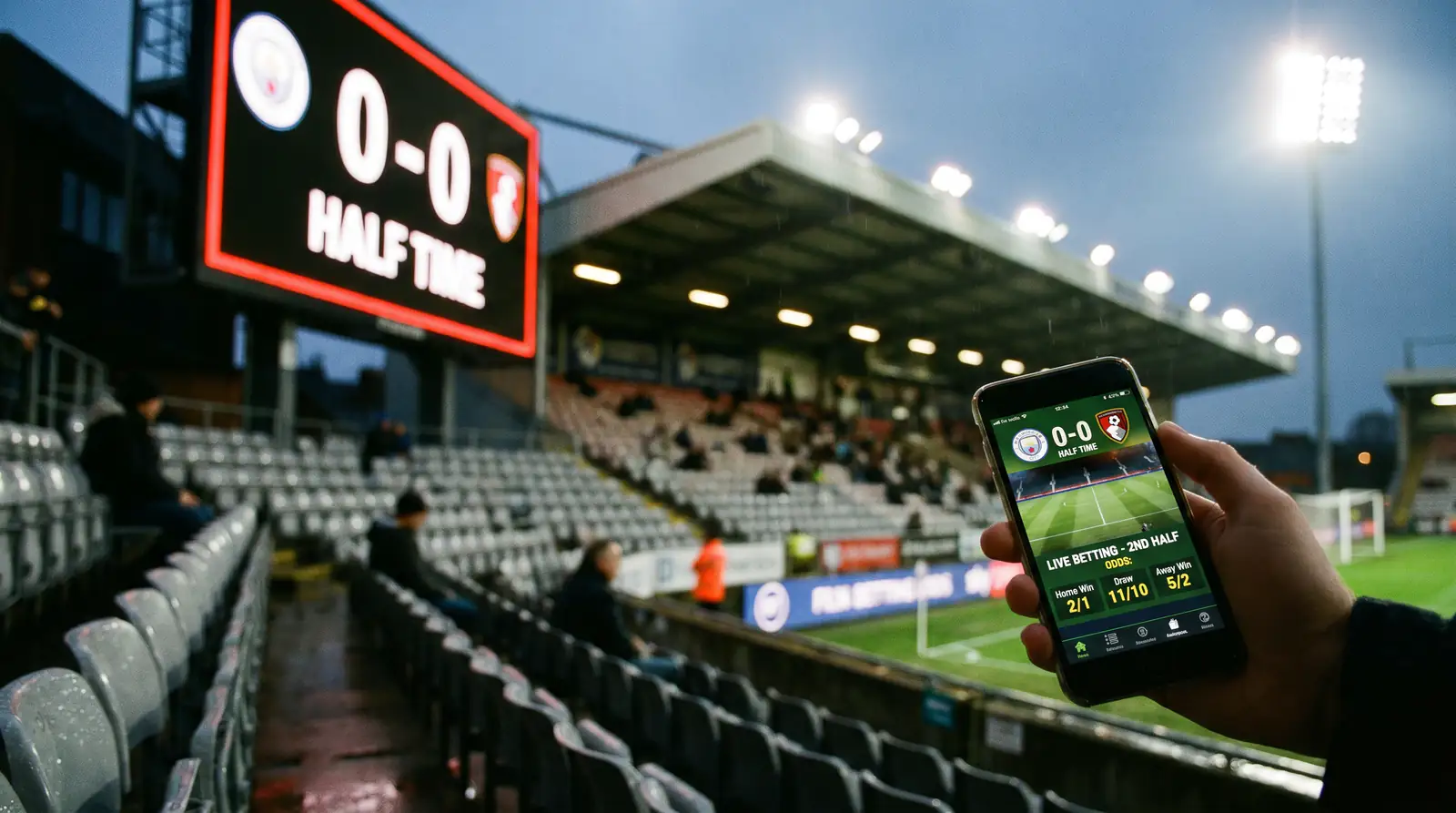
Half-time itself is a distinct window. Markets remain open through the break, but the fifteen-minute pause gives you time to reassess without the pressure of a live ball. You can review first-half stats, check whether your pre-match assessment was accurate, and decide whether a second-half bet is justified. I’ve found that half-time is often the point where the market overreacts to the first-half scoreline. A 0-0 scoreline after a half where both teams created multiple clear chances doesn’t mean goals aren’t coming — it might mean the second half Over market is more attractively priced than the first-half evidence warrants.
The final ten minutes, by contrast, are a trap for most bettors. The urgency of the clock ticking down creates a feeling that “something has to happen,” which is a cognitive bias, not a market insight. Late goals in matches where a team is chasing are real and predictable to some degree. But the prices already reflect that expectation. Backing a team to equalise at 85 minutes because they “look desperate” is usually paying for emotion, not for an edge the market has missed.
Cash Out and Partial Cash Out in Live Betting
Cash out is a live betting feature, even when it’s applied to a pre-match bet. The moment the match starts, your pre-match bet becomes a live position, and the cash-out value adjusts in real time based on the score, the time elapsed, and the bookmaker’s live model.
The mechanics are straightforward: the bookmaker calculates what your bet is worth at any given moment and offers you that amount, minus a margin. If you backed a team at 3.00 pre-match and they’re winning 1-0 at 70 minutes, the cash-out offer might be 75-80% of the potential full payout. You can take that guaranteed amount or let the bet run. The bookmaker’s margin on the cash-out price means you’re always getting slightly less than the “true” in-play value of your position.
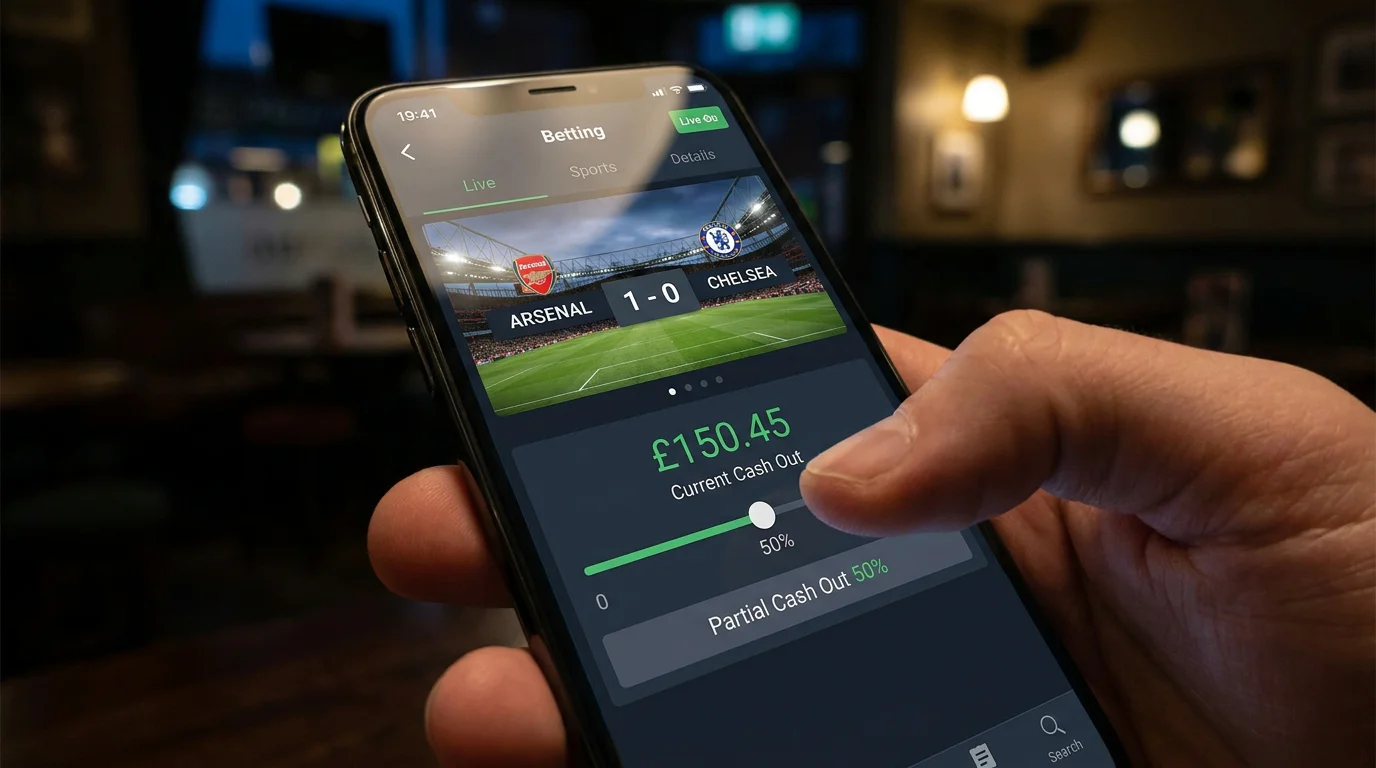
Partial cash out is the more strategically interesting option. You can cash out a portion of your bet — say, 50% or 70% — and leave the remainder active. This lets you lock in some profit while maintaining exposure to the full outcome. If the team holds on and wins, you collect the partial cash out plus the payout on the remaining stake. If they concede and the bet loses, you keep the cashed-out portion. It’s a hedging tool, and like all hedging, it reduces both risk and upside.
The scenarios where cashing out makes mathematical sense are narrower than most bettors assume. Cashing out because you’re nervous is an emotional decision, not an analytical one. Cashing out because the match situation has genuinely changed — a key player injured, a tactical shift that undermines your pre-match thesis — is an analytical decision. The distinction matters, because over hundreds of bets, cashing out emotionally costs you more in foregone value than the occasional late equaliser costs you in lost bets. For a deeper look at the maths of when to hold and when to fold, the full cash-out strategy breakdown works through the numbers in detail.
Latency, Suspension, and the Risks of Live Betting
Live betting has a structural asymmetry that works against you: the bookmaker knows what’s happened before you do. Not by hours or minutes, but by seconds. And in a market that reprices in real time, seconds matter enormously.
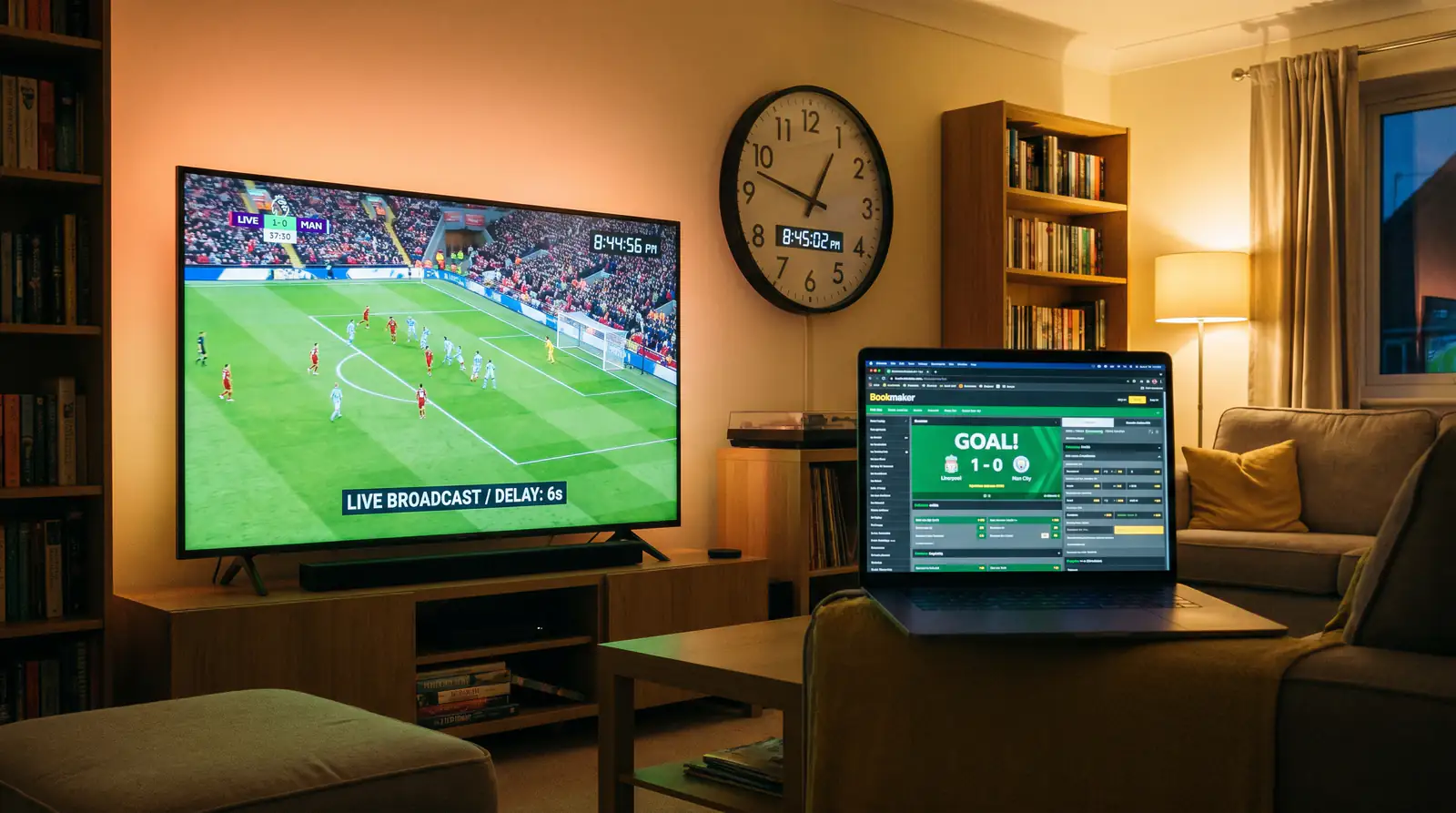
The latency gap works like this. The bookmaker’s data feed, supplied by a company with people at the match, transmits events (goals, corners, cards) faster than any broadcast. Your live stream, even the fastest one, carries a delay of somewhere between three and fifteen seconds. When a goal goes in, the bookmaker’s algorithm has already suspended the market, recalculated the odds, and prepared to reopen at new prices before the ball hits the net on your screen. If you try to bet into a goal that you’ve seen on the stream but the bookmaker already knows about, the bet will be rejected or voided.
Market suspensions are the bookmaker’s primary risk management tool in-play. Markets suspend automatically around goals, red cards, penalties, and sometimes corners and substitutions. The duration of the suspension varies by operator and by event type. A goal might suspend markets for 30-90 seconds. A red card might trigger a longer suspension while the algorithm reprices the entire match. During these suspensions, you can’t bet — which means the highest-impact moments in the match are precisely the moments when you’re locked out of the market.
Then there’s the psychological risk. Live betting is faster, more stimulating, and more emotionally engaging than pre-match betting. The temptation to chase a loss in real time is powerful — you can see the match unfolding, and it feels like the opportunity to “get it back” is right there. Grainne Hurst of the Betting and Gaming Council emphasises that betting is a “genuinely enjoyable experience” for 22 million monthly participants, and for the majority it is. But the same qualities that make live betting enjoyable — immediacy, engagement, real-time feedback — also make it the format most conducive to impulsive decision-making. The 2.7% of UK adults who score as problem gamblers on the PGSI scale, and the 5.3% rate among 18-24 year olds, are reminders that the line between engagement and compulsion is not always clear.
My personal rule: I never place a live bet that I haven’t at least partially thought through before kick-off. If I didn’t consider the match worth analysing pre-match, I don’t bet on it in-play. This rule eliminates the majority of impulsive live bets and keeps my in-play activity tied to matches where I have an analytical framework, not just a television and a hunch.
Live vs Pre-Match: Where the Edge Sits
The question I get asked most often about in-play betting is whether it’s “more profitable” than pre-match. The honest answer: it depends entirely on you. The market itself doesn’t inherently offer more or less value in-play than pre-match. What changes is the information available to you and the conditions under which you process it.
Pre-match, you have unlimited time to analyse. You can review stats, read team news, compare prices across operators, run your EV calculations, and make a decision without time pressure. The bookmaker’s pre-match prices reflect all publicly available information, but you can take as long as you need to assess whether you disagree with those prices.
In-play, you have more information — you can see the actual match unfolding — but less time to process it. The team you fancied pre-match might be playing poorly, which should update your assessment, but you need to distinguish between “they’re playing badly and my pre-match thesis is wrong” and “they’re playing badly in a way that’s temporary and the market is overreacting.” Making that distinction in real time, under the emotional influence of watching the match, is genuinely difficult. Football generates £1.3 billion in GGY for remote operators, and a growing share of that comes from in-play markets where bettors make faster, less considered decisions.
Where live betting offers a structural advantage is in matches where you’re watching something the data doesn’t capture. A team’s body language, a tactical setup that creates repeated chances from a specific area, a goalkeeper who looks unsettled on crosses — these are real-time observations that won’t show up in the stats until the match is over. If you can process these observations quickly and translate them into a probability assessment that differs from the live market, you have an edge. If you can’t — if you’re just reacting emotionally to what you see — you’re better off sticking to pre-match.

In-Play Betting Rewards Preparation, Not Reflexes
The best live bettors I know are not the quickest on the draw. They’re the most prepared. They go into every match with a plan, a set of triggers, and a clear sense of what would make them bet and what would make them hold. When the trigger fires, they act. When it doesn’t, they close the app and watch the match as a neutral. That discipline, more than speed or market knowledge, is what separates profitable live betting from expensive entertainment.
FAQ
What football markets are available for in-play betting?
Major UK operators offer match result, next goal, goals totals (over/under), correct score, both teams to score, corners, cards, and player-specific markets during live football matches. The range narrows as the match progresses, and some micro-markets like next throw-in are available only at certain operators. Markets suspend briefly around goals, red cards, and other significant events while odds recalculate.
How fast do live football odds change during a match?
In-play odds update continuously, repricing every few seconds based on time elapsed, score, and match dynamics. After a goal, markets typically suspend for 30 to 90 seconds before reopening at new prices. The bookmaker’s data feed is faster than any broadcast, so odds reflect events before they appear on your screen. Price movements of 30-40% in seconds are common after goals or red cards.
Is in-play betting more profitable than pre-match betting?
Not inherently. In-play betting gives you more information because you can watch the match, but it also demands faster decisions under greater emotional pressure. Bettors who prepare a specific plan before kick-off and stick to predefined triggers tend to perform better live than those who bet reactively. The structural latency disadvantage — bookmakers see events before you do — also means the market is harder to beat in real time than it is pre-match.
Can I use cash out on in-play football bets?
Yes, most UK operators offer cash out on in-play football bets. The cash-out value updates in real time as the match progresses. Partial cash out is also available at many operators, letting you lock in a portion of profit while leaving the rest of the bet active. The cash-out offer always includes a bookmaker margin, so the amount offered will be slightly less than the theoretical value of your position at that moment.
