
 Available in US
Content
- What Makes a Football Betting Site Worth Using in 2026
- UKGC Licensing: The Non-Negotiable First Check
- Football Market Depth: Pre-Match, In-Play, and Bet Builders
- Comparing Odds Quality Across UK Bookmakers
- Cash Out, Early Settlement, and Streaming
- Welcome Offers and Free Bets: What to Look For
- Red Flags: How to Spot an Unlicensed Operator
- Choose by Criteria, Not by Brand
- FAQ
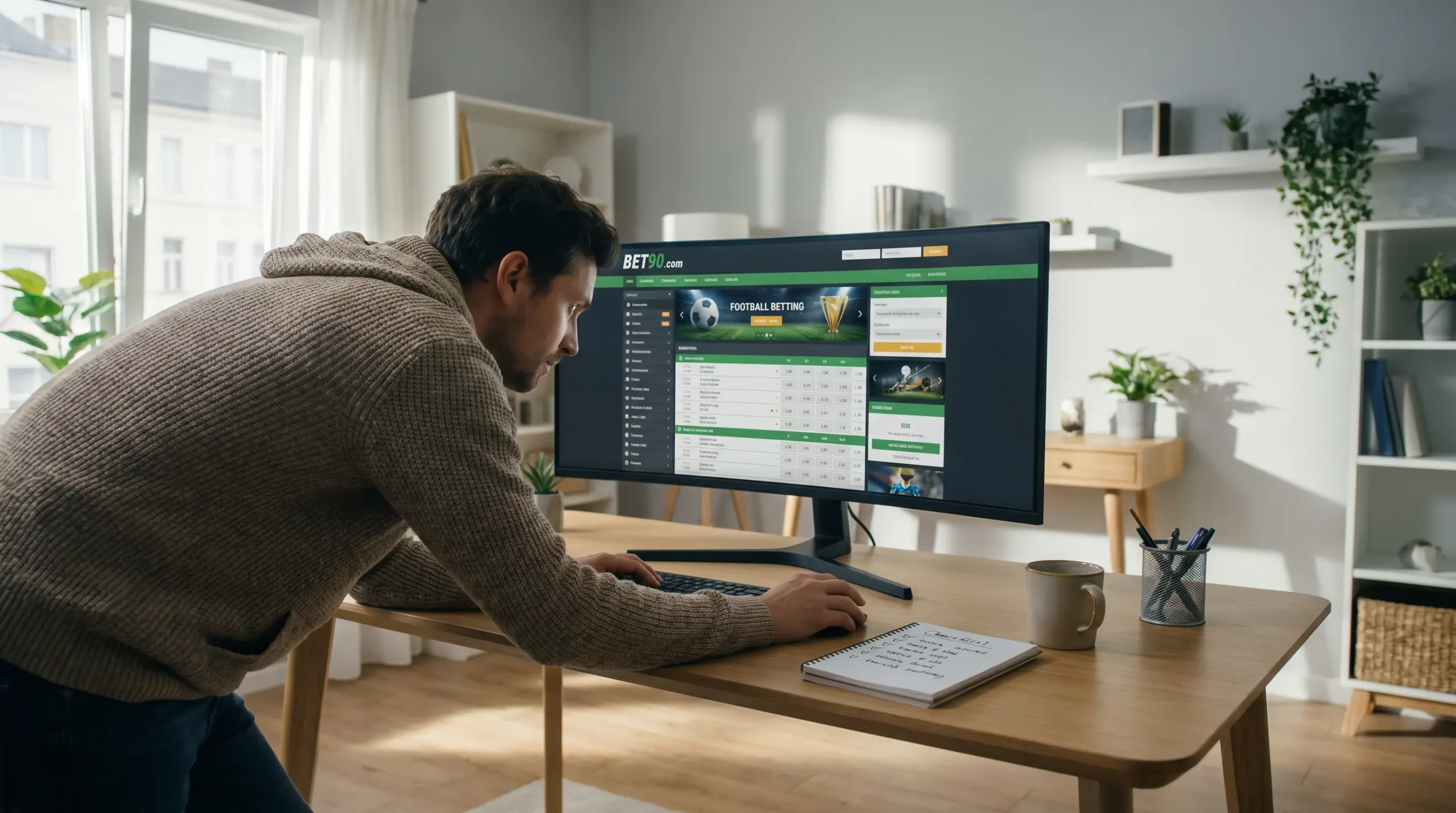
What Makes a Football Betting Site Worth Using in 2026
Two years ago, a colleague forwarded me a screenshot of odds he’d found on a football betting site I’d never heard of. The prices were absurdly generous — 20-30% better than anything on the regulated market. It took me about ninety seconds to check the Gambling Commission’s public register and confirm the obvious: the site wasn’t licensed. He’d deposited money with an operator that had no legal obligation to pay him out, no dispute resolution mechanism, and no accountability to any regulator on the planet.
That’s the starting point for any conversation about choosing a football betting site in 2026. The UK has 8,148 licensed gambling premises and a substantial number of licensed remote operators, all overseen by the UK Gambling Commission. Outside that framework, there’s a growing black market. In the financial year ending March 2026, the Gambling Commission issued 741 cease-and-desist orders and reported 397,527 URLs to search engines, of which 266,667 were removed. The enforcement effort is real, but so is the scale of the problem.
This guide isn’t a ranking of operators. I’m not going to tell you which bookmaker is “best” because that depends entirely on what you bet on, how you bet, and what features matter to you. Instead, this is a framework for evaluating any football betting site against the criteria that actually affect your experience and your money: licensing, market depth, odds quality, features, and the warning signs that should make you walk away.
UKGC Licensing: The Non-Negotiable First Check
Every football betting site operating legally in the UK must hold a licence from the UK Gambling Commission. No exceptions. No grey areas. If a site accepts bets from UK customers without a UKGC licence, it is operating illegally, and you have zero regulatory protection if something goes wrong.
Culture Secretary Lisa Nandy made this point sharply when addressing the problem of unlicensed operators sponsoring football clubs: “When placing a bet on the big match, fans deserve to know the sites they’re using are properly regulated, with the right protections in place.” That statement was directed at the sponsorship issue, but the principle applies to every bettor choosing where to open an account.
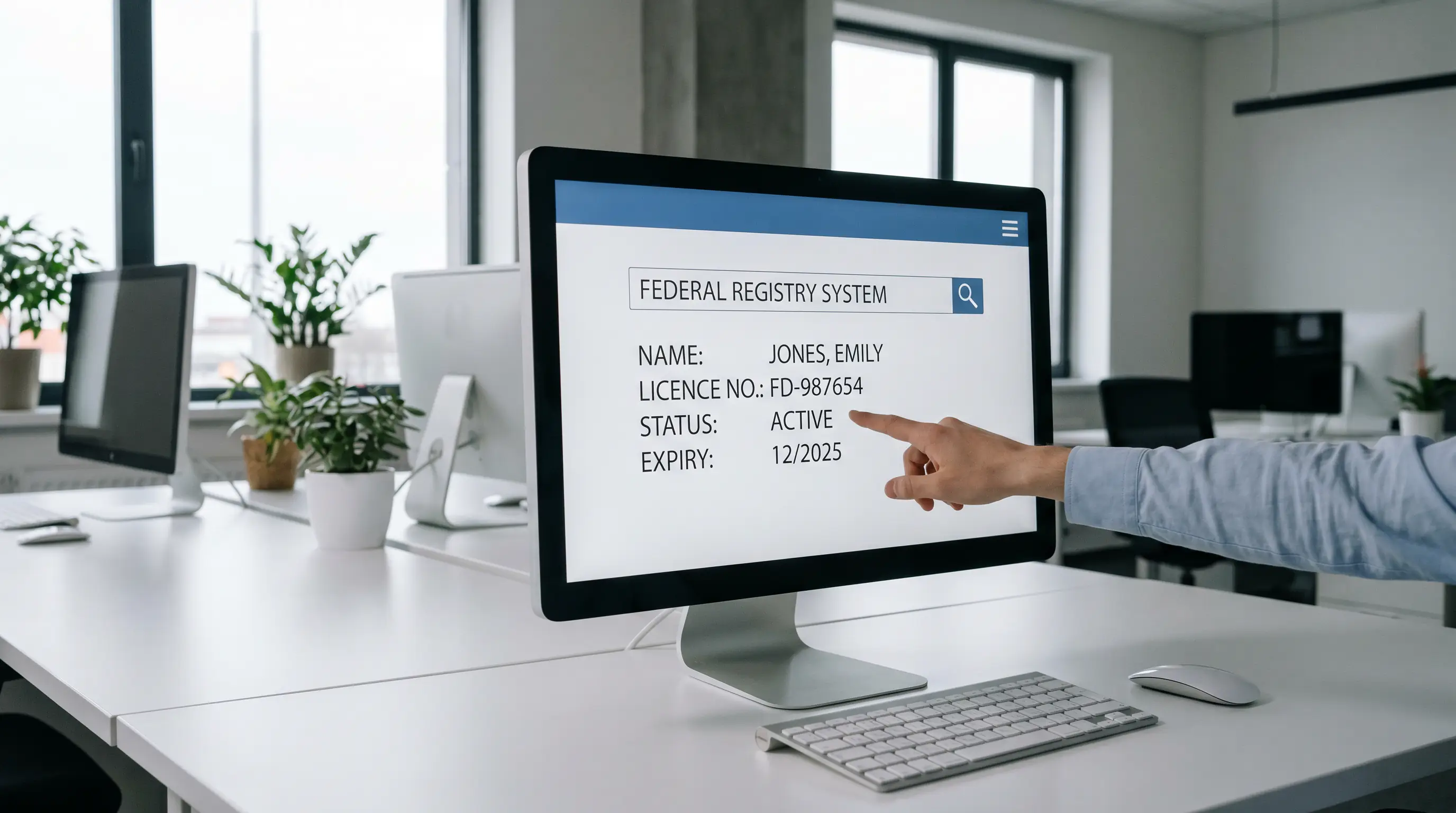
Checking is easy. The Gambling Commission maintains a searchable public register on its website. Enter the operator’s name, and you’ll see whether they hold a valid licence, what activities it covers, and whether any regulatory action has been taken against them. Every licensed operator is also required to display their licence number on their website, usually in the footer. If you can’t find a licence number, that’s your answer.
What does a UKGC licence actually give you as a bettor? Three things. First, your funds must be protected. Licensed operators are required to keep customer funds segregated or protected in a way that ensures you can withdraw your money even if the company fails. Second, you have access to an approved alternative dispute resolution service if you disagree with how a bet was settled. Third, the operator is subject to ongoing compliance requirements around fairness, transparency, and responsible gambling tools — including deposit limits, self-exclusion, and the financial risk assessments that are currently being rolled out.
I keep accounts with multiple licensed operators, and I’ve had disputes with two of them over the years. In both cases, the ADR process resolved the issue. Not in my favour each time, but fairly, with transparency about the reasoning. Try getting that from an unlicensed offshore site. You won’t even find a complaints email address.
The regulatory landscape is also shifting in ways that affect licensed operators directly. The financial risk assessment pilot found that fewer than 3% of active accounts were flagged for review, and 97% of those passed the check frictionlessly. The new Remote Gaming Duty rate of 40%, effective from April 2026, means licensed operators are carrying heavier tax burdens than ever. Some bettors see regulation as an inconvenience. I see it as the cost of a market where your money is protected, your bets are settled fairly, and the operator can’t vanish overnight with your balance. That cost is worth paying.
Football Market Depth: Pre-Match, In-Play, and Bet Builders
Not all bookmakers cover football to the same depth, and the differences matter more than most bettors realise. A Premier League match at a major operator might offer 200+ individual markets: match result, correct score, goals totals, Asian handicaps, corners, cards, player props, half-time/full-time, and bet builders that combine them. The same match at a smaller operator might offer thirty.
If you only ever bet on 1X2 match results, market depth is irrelevant. But if you’ve developed a strategy around specific markets — Over/Under goals, BTTS, Asian handicaps, live in-play markets — then the operator’s coverage of those markets is critical. I’ve found situations where my analysis pointed clearly to an Asian handicap bet, but the bookmaker I was logged into didn’t offer the specific line I needed. Having a second or third account with an operator that covers Asian markets in depth solved the problem, but I had to set that up in advance.
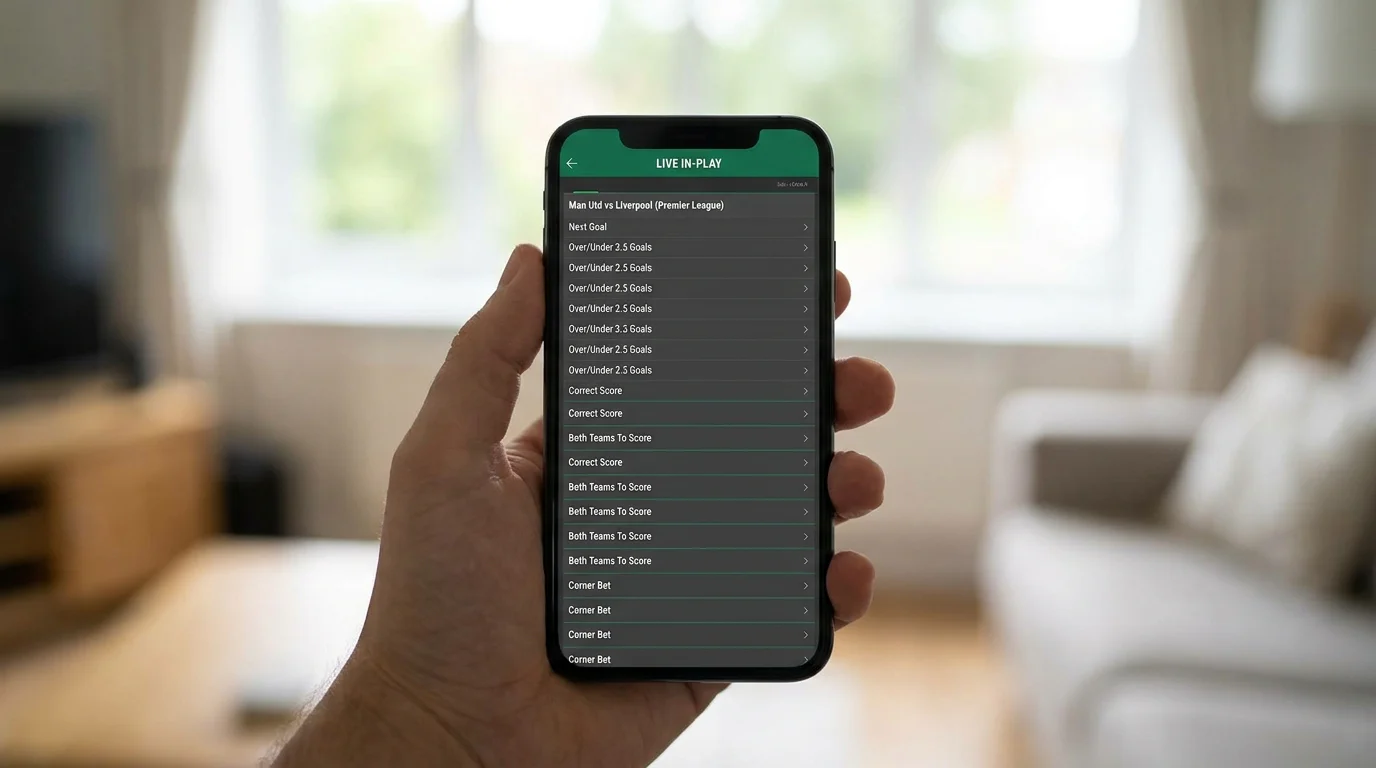
Pre-match market depth is one thing. In-play depth is another, and it’s where operators diverge most dramatically. Six percent of all UK adults bet on live football, and the demand for in-play markets has driven significant investment from the larger operators. The best in-play platforms offer real-time match result, next goal, goals over/under, corners, and a range of player-level markets, all updated in seconds. Others suspend markets for extended periods around key match events, leaving you unable to bet precisely when the opportunities are richest.
Bet builders have become a marquee feature over the past few seasons. They let you combine multiple selections from the same match — say, a team to win, a player to score, and over 2.5 goals — into a single bet with a combined price. The pricing of bet builders varies substantially between operators because each one uses its own model to account for correlation between legs. The same combination might pay 8.00 at one site and 6.50 at another, and neither price is necessarily “wrong” — they reflect different correlation assumptions. If bet builders are part of your approach, compare how different operators price the same combinations.
Comparing Odds Quality Across UK Bookmakers
A bookmaker with 200 markets but consistently poor prices is worse than one with 50 markets and sharp odds. Odds quality — how close the offered price is to the “true” probability — is the single biggest factor in your long-term results, and it varies meaningfully across UK operators.
I spent a month last year tracking the overround on Premier League match result markets across six operators for every Saturday fixture. The difference between the tightest and widest was roughly 2.5 percentage points, which might sound trivial until you do the maths across a full season of betting. That 2.5% is margin flowing from your pocket to theirs on every single bet. Over 200 bets at an average stake of £20, you’re paying an extra £100 per year for the privilege of using a less competitive bookmaker.
The picture gets more dramatic in less popular markets. Correct score overrounds can vary by 15-20 percentage points between operators. Goal scorer markets show similar spread. The general pattern: the largest operators with the highest volumes tend to offer tighter margins on headline markets because they can afford to — the volume compensates for the thinner edge. Smaller operators compensate for lower volume with wider margins.
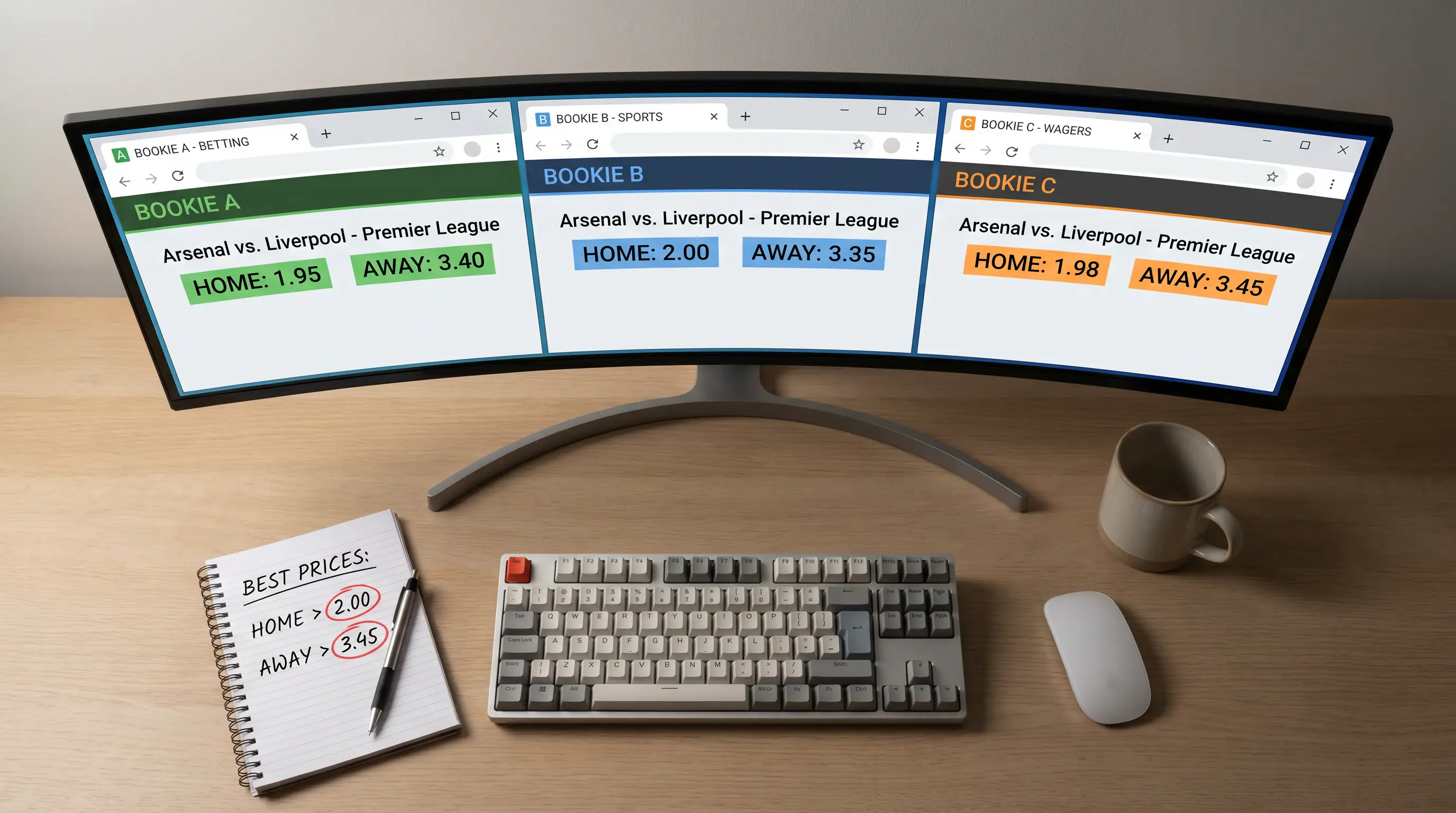
How do you assess odds quality without running a month-long study? The quick method: for any match you’re considering, check the price on at least three operators. The one consistently offering the best price on a given market type is likely the most competitive for that market. Over time, you’ll map out which operators are strongest where. This is the practical side of line shopping, and it’s the easiest structural improvement any football bettor can make. Flutter’s UK and Ireland sports betting revenue of roughly $1.7 billion in 2024 came in part from bettors who didn’t bother to compare prices across operators. Don’t be one of them.
Betting exchanges deserve a separate mention here. Because exchanges match bettors against each other rather than taking the opposite side, there’s no overround in the traditional sense. The exchange takes a commission on net winnings — typically 2-5% — but the odds available are often sharper than any bookmaker offers, particularly on high-liquidity markets like Premier League match results. The trade-off is that you need someone to match your bet, and on niche markets the liquidity might not be there. For popular football markets, though, exchange odds frequently represent the best available price.
Cash Out, Early Settlement, and Streaming
Cash out changed the way I think about football bets. Before it existed, every bet was binary — it either won or it lost. Now, you can close a position mid-match for a guaranteed return, partial or full. It’s a powerful tool, but it’s not free. The cash-out price always includes a margin that favours the bookmaker, so every time you take the offer, you’re accepting a mathematically worse deal than letting the bet run to its conclusion. Whether that trade-off makes sense depends on your situation, your risk tolerance, and the specific circumstances of the match.
Partial cash out is more useful than most people give it credit for. It lets you lock in some profit while leaving the rest of the bet live. If you’ve backed a team at 3.00 and they score early, you can cash out half your stake at a profit and let the other half ride. It’s a risk management tool, not a profit maximisation tool, and understanding the distinction matters.
Live streaming is another feature that varies across operators. Some offer live video feeds for a wide range of football matches, including lower leagues and international competitions. Others restrict streaming to matches where you have a qualifying bet or active account. If you bet on in-play markets, access to a live stream — even with a slight delay — is significantly more useful than relying on text commentary or match trackers. The delay between the stream and the live odds is a factor, though: the bookmaker’s in-play prices react to events before your stream shows them, which means you’re always slightly behind.
Statistics and data integration within the betting platform is increasingly common. Some operators offer embedded form guides, head-to-head records, and basic stats alongside their odds. These are convenient but rarely sufficient for serious analysis. Think of them as a supplement, not a substitute, for your own research process.

Responsible gambling tools are a feature category that deserves more attention than it gets. The ability to set deposit limits (daily, weekly, monthly), session time alerts, reality checks that pause your betting at regular intervals, and self-exclusion options should be standard at any site you use. The quality of implementation varies — some operators make these tools prominent and easy to access, while others bury them in account settings. Given that 2.7% of UK adults score as problem gamblers on the PGSI scale and the 18-24 age group is most at risk, the accessibility and quality of these tools is a legitimate criterion for choosing an operator, not an afterthought.
Welcome Offers and Free Bets: What to Look For
Free bets and welcome offers are the first thing most new customers see, and the last thing they should choose a bookmaker based on. A generous sign-up offer with poor ongoing odds is a worse deal than a modest offer with competitive everyday pricing. The offer gets you in the door; the odds determine whether you stay.
That said, welcome offers have value if you understand the terms. New account registrations across remote betting operators totalled 34.0 million in 2024-25, a decline of 4.1% year-on-year — which suggests that operators are competing harder for each new customer. The offers reflect that competition.
The most common structures: “bet and get” (place a qualifying bet, receive a free bet of equal value), matched deposit (deposit X, get X in bonus funds), and risk-free first bet (if your first bet loses, the stake is refunded as a free bet). In every case, read the terms. What are the minimum odds for the qualifying bet? Does the free bet stake get returned if it wins, or just the profit? Is there a wagering requirement on bonus funds? These details determine whether the offer is worth engaging with or whether it’s designed to funnel you into bets you wouldn’t otherwise place.
For matched betting approaches using football free bets, the specific terms of each offer are critical. A “stake not returned” free bet has a different mathematical value than a “stake returned” one, and the qualifying bet requirements affect the overall expected profit from the promotion. If you’re methodical about it, welcome offers across multiple operators can generate a meaningful return. If you’re not, you’ll end up placing careless qualifying bets that cost you more than the free bet is worth.

Red Flags: How to Spot an Unlicensed Operator
1.5 million UK adults already bet on unlicensed sites, placing an estimated £10 billion in stakes outside UK regulation each year. H2 Gambling Capital projects that figure will nearly double to £33 billion by 2028. The black market isn’t a fringe problem — it’s a growing parallel economy, and it actively tries to attract UK football bettors.
The red flags are consistent. An operator with no visible UKGC licence number — typically displayed in the website footer — is the most obvious. But there are subtler signs. Payment methods limited to cryptocurrency or e-wallets with no option for UK bank transfers or debit cards. Odds that are dramatically better than anything on the regulated market, which sounds attractive until you consider that the operator has no margin, no regulatory cost, and no obligation to actually pay you. Customer support that’s accessible only via Telegram or WhatsApp rather than through a proper support system.
Social media advertising from unlicensed operators is a growing vector, particularly targeting younger bettors. Around 420,000 UK school-age children are estimated to access black market gambling through social media, VPNs, and crypto wallets. For adults, the entry points are similar: sponsored posts, influencer promotions, and affiliate links that lead to unregulated platforms offering inflated odds and unverifiable promotions.
The Gambling Commission’s enforcement is active — 741 cease-and-desist orders and disruption of 1,134 sites in the last financial year — but the scale of the internet means new unlicensed sites appear faster than regulators can shut them down. Your protection is simple: verify the licence before you deposit. If the site isn’t on the Gambling Commission’s register, your money isn’t protected by UK law, and no odds advantage is worth that risk.

Choose by Criteria, Not by Brand
The “best” football betting site doesn’t exist in the abstract. It exists relative to your needs. If you bet primarily on Asian handicaps, the operator with the deepest AH coverage and the tightest margins on that market is your best option — even if their welcome offer is unremarkable. If you bet in-play, the speed and reliability of the live platform matters more than the range of pre-match props. If responsible gambling tools are a priority, the quality of deposit limits, session alerts, and self-exclusion implementation varies between operators.
Open accounts with three or four licensed operators. Test them with small stakes. Assess the odds quality, market depth, and user experience for the specific football markets you bet on. Keep the accounts that perform, close the ones that don’t. That process, repeated over a few weeks, will tell you more about which sites suit your betting than any ranking list ever could.
FAQ
How do I check if a football betting site is licensed by the UKGC?
Visit the UK Gambling Commission’s website and use their public register search. Enter the operator’s name or brand, and the register will show whether they hold a valid licence. Every licensed operator is also required to display their licence number on their website, usually in the footer near the terms and conditions. If you cannot find a licence number on the site and cannot find the operator in the UKGC register, do not deposit money with them.
What is the difference between a bookmaker and a betting exchange?
A bookmaker sets the odds and takes the other side of your bet directly. Their profit comes from the margin built into the odds. A betting exchange is a platform where you bet against other customers. You can back an outcome to happen or lay it to act as the bookmaker yourself. The exchange takes a commission on winning bets, typically 2-5%. Exchange odds are often better than bookmaker odds because there is no overround, but liquidity can be limited on less popular markets.
Are offshore betting sites safe for UK customers?
If an offshore site does not hold a UK Gambling Commission licence, it is operating illegally in the UK market. Your deposits are not protected, you have no access to alternative dispute resolution, and the operator has no obligation to honour withdrawals or settle bets fairly. The slightly better odds sometimes offered by unlicensed sites are not worth the complete absence of regulatory protection. Stick to UKGC-licensed operators.
Do all UK betting sites offer football bet builders?
Most major UK operators now offer bet builder functionality for football, but the range of available selections, the number of leagues covered, and the pricing models vary significantly. Some operators allow up to 12 or more legs in a bet builder, while others cap it at six. The pricing also differs because each operator uses its own model to account for the correlation between legs within the same match. Compare bet builder prices across operators before placing, as the differences can be substantial.
