
 Available in US
Content
- Why Most Football Betting Strategies Fail — and What the Data Says
- Value Betting: Finding Edges the Market Misses
- Line Shopping: Extracting Extra Points from the Market
- Staking Systems: Flat, Percentage, and Kelly Criterion
- The Pareto Principle Applied to Football Betting
- League Specialisation: Why Less Coverage Means More Edge
- The Pre-Match Analysis Checklist
- Six Mistakes That Drain Your Bankroll
- Your Edge Is Your Process, Not Your Predictions
- FAQ

Why Most Football Betting Strategies Fail — and What the Data Says
Three years ago I sat in a pub in Manchester with a mate who’d been betting on football for a decade. He had a system, he told me — back the home side when they’d lost two in a row, because “the bounce always comes.” He’d been doing this for years. I asked him what his overall return looked like. He had no idea. He’d never tracked it.
That conversation stuck with me because it captures the way most people approach football betting strategies: gut feeling dressed up as method. The UK remote betting market generated GGY of £2.6 billion in the year to March 2025, with football alone accounting for £1.3 billion. That money flows from millions of bettors into the hands of operators who are extremely good at setting prices. The idea that a simple heuristic — “back the bounce,” “always take the draw,” “follow the tipster” — can consistently beat that machine is, to put it politely, optimistic.
The UK online gambling market is projected to grow from $9.0 billion in 2025 to $13.2 billion by 2034. The operators are investing heavily in pricing models, data infrastructure, and risk management. If you want to sit on the other side of that equation and come out ahead, you need strategies grounded in something more durable than instinct. This guide covers six approaches that survive contact with real data — not because they guarantee profit, but because they address the structural realities of how football betting markets work.
None of what follows is a shortcut. Every strategy here demands discipline, record-keeping, and a willingness to do work most bettors skip. But if you’re serious about turning football betting from entertainment into something closer to a structured activity, these are the methods worth your time.
Value Betting: Finding Edges the Market Misses
I remember the first time value betting actually clicked for me. I was looking at a Championship match where the away side was priced at 4.50 to win. The bookmaker’s implied probability was about 22%. But I’d been tracking this team’s away form, their xG numbers, the opposition’s defensive injuries — and my own assessment put their win probability closer to 28%. That gap, six percentage points, was value. Not a guarantee. Not a “lock.” Just a price that was wrong in my favour.
Value betting is the only football betting strategy that has a coherent mathematical foundation. The core idea is disarmingly simple: you bet when the odds offered by the bookmaker imply a lower probability than your own estimated probability of the outcome. Over hundreds of bets, if your probability estimates are more accurate than the market’s, you profit. If they’re not, you don’t. There’s no trick to it beyond that.
The difficulty, obviously, is in the estimation. Bookmakers employ teams of traders, feed data through sophisticated models, and adjust prices in real time. You’re competing against that. But bookmakers also have structural constraints that create pockets of inefficiency. They need to balance their books across thousands of markets. They shade odds toward popular outcomes because recreational money tends to back favourites and big teams. They set lines for lower-league matches with less precision because the volume doesn’t justify the same analytical investment.
These inefficiencies are where value betting in football becomes viable. Not in the headline Premier League match where every trader on the planet is watching, but in the margins — the midweek League One fixture, the early-season match where squad changes haven’t been priced in, the game where a key defender is out but the market hasn’t moved.
The practical question is how you build a probability estimate that’s better than the market’s, even occasionally. You don’t need a supercomputer. You need a systematic process: collect the same set of data points for every match you assess, weight them consistently, and compare your output to the available odds. When there’s a gap in your favour, you bet. When there isn’t, you don’t. The discipline to walk away from a match you’ve spent thirty minutes analysing, simply because the price isn’t there, separates value bettors from everyone else.
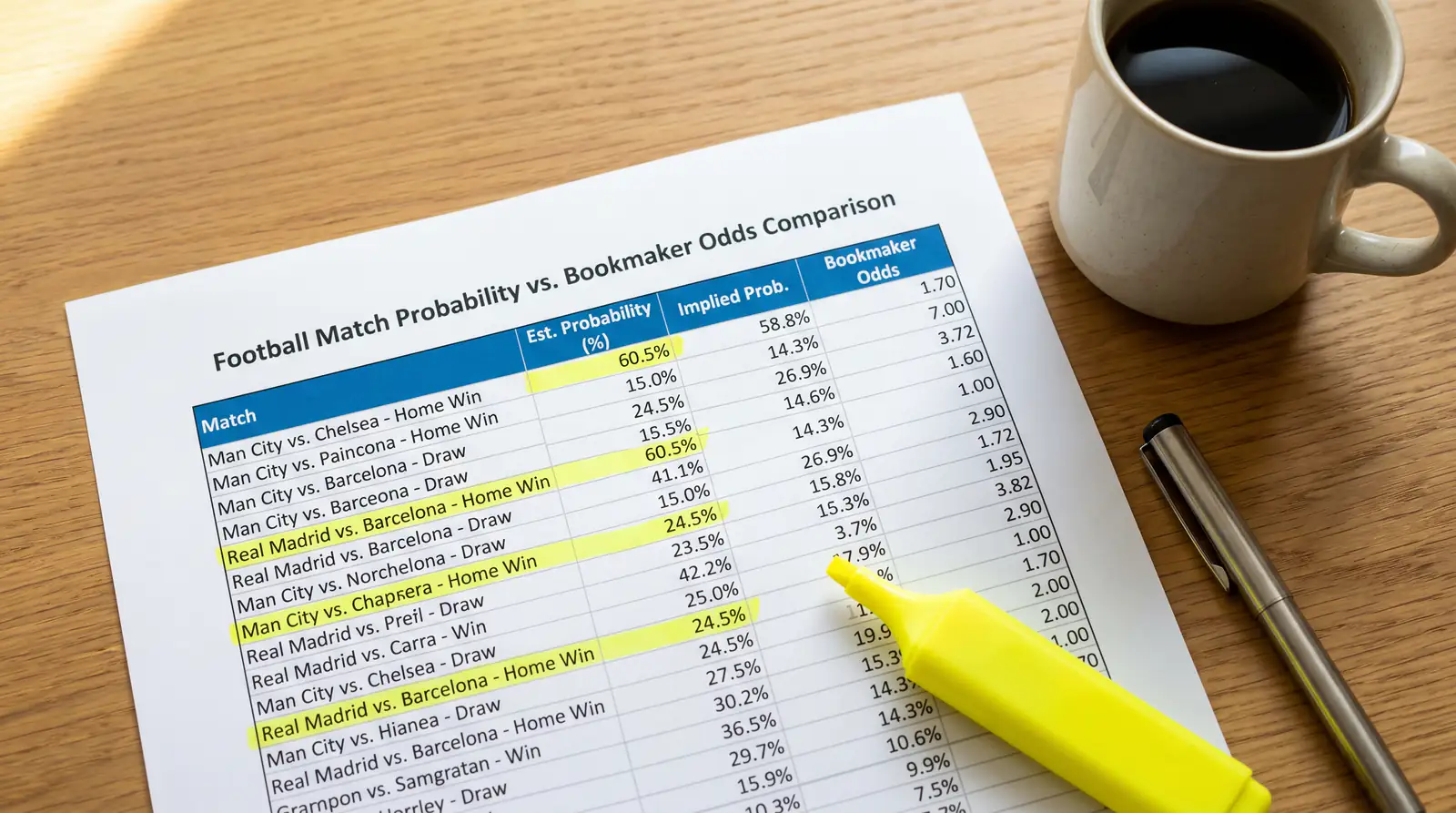
The Expected Value Formula in Practice
Expected Value is the formula that tells you whether a bet is worth placing, regardless of whether that specific bet wins or loses. It works like this:
EV = (Probability of Winning x Net Profit if Win) – (Probability of Losing x Stake Lost if Lose)
Say you estimate a team has a 30% chance of winning, and the bookmaker offers decimal odds of 4.00. Your calculation: (0.30 x 3.00) – (0.70 x 1.00) = 0.90 – 0.70 = +0.20. That’s a positive expected value of 20p per pound staked. Over time, placing bets with positive EV is the only mathematically sound approach to profitable betting.
Now flip it. Same match, but the odds are 3.00 instead. The calculation: (0.30 x 2.00) – (0.70 x 1.00) = 0.60 – 0.70 = -0.10. Negative EV. The price isn’t wrong enough to justify a bet, even though your analysis says the team has a decent chance. This is where most bettors fall apart — they back outcomes they “fancy” regardless of whether the price compensates for the risk.
The formula itself is simple arithmetic. The hard part is the first variable: your probability estimate. Getting that consistently closer to reality than the bookmaker does is a skill built over months of tracking, adjusting, and honestly reviewing your results. I still get it wrong more often than I get it right on any individual match. But if my estimates are calibrated well enough across 200 or 300 bets, the edge compounds.
Line Shopping: Extracting Extra Points from the Market
Here’s something that still surprises me after years in this: the same match, the same market, the same kick-off time, and two licensed UK bookmakers will offer noticeably different odds. Not always, and not by huge margins, but often enough that it matters. I’ve seen Over 2.5 Goals priced at 1.85 on one site and 2.00 on another for the same Premier League fixture. That’s an 8% difference in implied probability on the exact same outcome.
Line shopping is the practice of holding accounts with multiple bookmakers and always placing your bet at the best available price. It sounds almost too obvious to qualify as a strategy, but most bettors don’t do it. They have one account, maybe two, and they take whatever price is in front of them. Over a season of betting, the cumulative effect of consistently taking 1.95 instead of 1.85, or 3.60 instead of 3.40, is enormous. It can be the difference between a losing year and a breakeven one.
The UK market makes this straightforward. There are 24.4 million active accounts across remote betting operators, and the licensing framework means you can open accounts with a dozen bookmakers in an afternoon. Each one sets its own prices based on its own model, its own book exposure, and its own customer base. The divergence is greatest in less liquid markets — lower-league football, Asian handicaps, correct scores — and smallest in the headline markets everyone watches.
A practical approach: before placing any bet, check the price at a minimum of three operators. Use odds comparison tools if you want, but the manual check is just as effective and teaches you which bookmakers consistently offer the best prices in the markets you bet on. Over time, you’ll find patterns. One operator might consistently shade their Over/Under lines tighter. Another might be slow to adjust Championship prices on a Saturday morning. These patterns are your free edge, and they require no analytical skill beyond the willingness to look.

The limitation is real, though. Bookmakers notice when you consistently take their best prices and win. Account restrictions — reduced maximum stakes, suspended promotions — are common for sharp bettors. It’s the cost of doing business. But even with restrictions, maintaining multiple accounts and shopping for the best line remains one of the simplest, most reliable ways to improve your long-term results.
Staking Systems: Flat, Percentage, and Kelly Criterion
A losing month taught me more about staking than any book ever did. I’d had a strong run — twelve winners from twenty bets — and started increasing my stakes because I felt “hot.” Three losses in a row at inflated stakes wiped out six weeks of profit in seventy-two hours. The bets themselves weren’t bad. My process hadn’t changed. But my staking had gone from disciplined to emotional, and the bankroll paid the price.
Staking systems determine how much you bet on each selection, and they matter far more than most people realise. You can have a genuine edge in your selections and still lose money if your staking is erratic. The three main approaches each suit different profiles.
Flat staking is the simplest: you bet the same amount on every selection, typically 1-2% of your total bankroll. If your bank is £1,000, every bet is £10 or £20 regardless of how confident you feel. The advantage is that it removes emotion entirely. The disadvantage is that it doesn’t account for situations where your edge is larger — you bet the same on a 5% edge as you would on a 1% edge.
Percentage staking adjusts your stake to a fixed percentage of your current bankroll. As your bankroll grows, your stakes grow with it. As it shrinks, your stakes shrink too, which provides a natural cushion against losing runs. The typical range is 1-3% per bet. This is what I use for most of my football betting, set at 1.5%. It keeps me in the game during cold streaks and lets the bankroll compound during good ones.
The Kelly Criterion is the most mathematically sophisticated approach. It calculates the optimal stake based on your perceived edge and the odds offered. The formula: Stake % = (bp – q) / b, where b is the decimal odds minus 1, p is your estimated probability of winning, and q is 1 minus p. If you estimate a 40% chance at odds of 3.00, Kelly says: ((2.00 x 0.40) – 0.60) / 2.00 = 0.10, or 10% of your bankroll. In practice, most serious bettors use “fractional Kelly” — a quarter or half of the full Kelly stake — because overestimating your edge even slightly leads to aggressive stakes that can blow up your bank. If you want to build a proper bankroll framework with calculated unit sizes, fractional Kelly is worth understanding even if you ultimately stick with percentage staking.

The right system depends on how accurately you can estimate your edge. If you’re confident in your probability assessments, fractional Kelly extracts the most value. If you’re still developing your process and aren’t sure how well-calibrated your estimates are, flat or percentage staking keeps you alive while you learn.
The Pareto Principle Applied to Football Betting
Most bettors bet too much. Not in money — in volume. They place ten or fifteen bets on a Saturday afternoon, covering Premier League, Serie A, Bundesliga, maybe a random MLS match because it’s on TV. When I started tracking my results properly, I found something uncomfortable: roughly 80% of my profit came from about 20% of my bets. The rest were noise at best, and a slow leak at worst.
The Pareto Principle — the idea that 80% of outcomes come from 20% of inputs — applies to football betting with uncomfortable precision. Your strongest opinions, the matches where your analysis is most thorough and your edge is clearest, generate the bulk of your returns. The filler bets, the ones placed because a match is about to start and you “might as well have something on it,” drag your results back toward the house edge.
I cut my betting volume by about half two seasons ago. Went from averaging twelve to fifteen bets per weekend to six or seven. My strike rate barely changed, my profit per bet increased noticeably, and I spent less time staring at odds screens and more time actually analysing the matches I chose to bet on. The quality of my research per match went up because I wasn’t spreading my attention across every fixture in Europe.
The practical application is straightforward: rank your potential bets by confidence before you place any of them. If your top five or six selections are the ones where your analysis is sharpest and the value is clearest, place those and stop. Resist the urge to add a seventh or eighth because “it looks good too.” The discipline to leave money on the table — to watch a match without having a stake on it — is one of the hardest things in betting, and one of the most profitable.
This doesn’t mean betting less is always better. It means betting selectively is. If you genuinely find twelve value bets in a weekend, back all twelve. But be honest about the difference between “I’ve found value here” and “I want to have a bet on this match.” Those are very different sentences, and confusing them is expensive.

League Specialisation: Why Less Coverage Means More Edge
Why would you compete against the entire market on a Premier League match when you could know more than almost anyone about the Scottish Premiership? That question changed the trajectory of my betting. The Premier League is the most-watched, most-analysed, most-bet-upon football competition on the planet. Bookmaker pricing is razor-sharp because the volume demands it. Finding an edge on a Liverpool vs Arsenal match means outperforming not just the bookmaker’s model, but the thousands of sharp bettors whose money has already moved the line.
Lower down the pyramid, the equation shifts. Football betting accounts for £1.3 billion in GGY across the UK market, but the vast majority of that volume sits on the top-tier competitions. League One, League Two, the Scottish Championship, the Welsh Premier League — these markets attract far less analytical attention and far less liquidity. The bookmaker’s margin might be wider, but the pricing is less precise. A bettor who watches every Exeter City match, knows which players are carrying knocks that haven’t made the team news, and understands the tactical patterns under the current manager has a genuine informational edge that simply doesn’t exist at the top level.
I specialised in the EFL Championship for three seasons before expanding back to the Premier League. During those years, my hit rate on Championship bets was consistently higher than on any other league. Not because Championship football is easier to predict — it’s notoriously chaotic — but because I was putting in work that the market wasn’t fully pricing in. I watched matches that most bettors only checked the scores for. I tracked managerial changes, January window disruption, and the specific fatigue patterns that hit clubs competing on multiple fronts for promotion. That granular knowledge translated into better probability estimates, which translated into more frequent value bets.
Six percent of all UK adults bet on football, and 9% of men do so on live matches alone. The overwhelming majority of that activity is concentrated on a handful of high-profile leagues. If you want to find edges, go where the crowd isn’t. Specialise in one or two leagues, invest the time to know them deeply, and accept that you’ll miss “obvious” bets in leagues you don’t follow. The opportunity cost of breadth is depth, and depth is where sustainable edges live.

The Pre-Match Analysis Checklist
Every profitable bettor I know has a process. Not a hunch, not a feeling, not a “I just know football” — a process. A sequence of steps they follow for every match they consider betting on, in the same order, every time. The steps vary from person to person, but the existence of a structured checklist doesn’t. Grainne Hurst of the Betting and Gaming Council notes that betting is “a genuinely enjoyable experience for 22 million people every month in the UK, and the vast majority do so safely and responsibly.” The distinction between recreational betting and strategic betting isn’t about enjoyment — it’s about process.
Here’s the pre-match analysis checklist I’ve refined over the past few years. It takes me about twenty to thirty minutes per match, and I won’t place a bet until I’ve completed every step.
Step one: recent form. Not the last five results, which is what most people check, but the underlying performance data. xG created and conceded, shots on target ratio, big chances created vs expected. A team that has won three of their last five but underperformed their xG in all three is riding luck, not form. A team that has drawn two and lost one but created the second-highest xG in the league over that period is about to turn results around.
Step two: team news and rotation. Check official press conferences, training ground reports, and reliable local journalists. In tournament football or during midweek fixture congestion, squad rotation changes the profile of a match entirely. A “full strength” price becomes misleading when half the first eleven is rested.
Step three: tactical matchup. How does the home side’s style interact with the away side’s setup? A team that presses high against an opponent that excels at playing through the press is a different proposition than the same team against a low-block side. This is where watching matches — not just reading stats — gives you an edge.
Step four: market context. What are the odds telling you? If the away side has drifted from 3.00 to 3.40 since the market opened, money has come for the home side. Is that because the sharp bettors see something, or because recreational money has piled on the favourite? This step isn’t about following the money blindly — it’s about understanding what the price movement reflects before you form your own view.

Step five: value assessment. Run your EV calculation. If it’s negative, stop. Close the tab. Watch the match for fun. This is the step that protects your bankroll from all the work you just did — because thorough analysis that leads to a negative-EV bet is still a bad bet.
Six Mistakes That Drain Your Bankroll
I’ve made every one of these mistakes. Some of them more than once. What follows isn’t theory — it’s a list of the things that actually cost me money before I learned to stop doing them.
Chasing losses. You lose a bet, so you immediately place another one at higher stakes to “get it back.” This is the single most destructive behaviour in football betting, and it accounts for more blown bankrolls than bad selections ever will. The antidote is a daily or weekly loss limit, set in advance, that you treat as a hard ceiling. When you hit it, you stop. No exceptions. The match can wait. Your bankroll can’t.
Betting without a staking plan. Staking £5 on one match and £50 on the next because you “really fancy” the second one isn’t a strategy. It’s emotional allocation of capital, and it means your results are driven more by the randomness of which bets you happened to size up than by the quality of your selections. Pick a staking system and stick to it.
Ignoring the price. “I think Liverpool will beat Brentford” is not a betting thesis. “I think Liverpool will beat Brentford, and the odds of 1.65 understate their probability of winning” is a betting thesis. The outcome you expect and the price you’re offered are two different things. Backing outcomes without assessing whether the price is fair is how recreational bettors fund the industry — and 2.7% of UK adults already score as problem gamblers on the PGSI scale, a reminder that unstructured betting carries real risks beyond just money.
Over-relying on accumulators. Accumulators are fun. They’re also mathematically stacked against you because the bookmaker’s margin compounds with every leg. A five-fold accumulator where each leg carries a 5% margin means you’re facing a combined margin of roughly 23%. I’m not saying never place an acca, but if accumulators make up most of your betting volume, your long-term expectation is deeply negative.
Betting on leagues you don’t follow. Having a “strong feeling” about a Ligue 1 match you’ve never watched isn’t analysis. It’s gambling in the purest sense. Every bet you place on a league you don’t know well is a bet where you have no informational edge and the bookmaker almost certainly does.
Failing to track your results. If you don’t record every bet — stake, odds, market, outcome, profit/loss — you have no way of knowing whether your strategy is working. You’ll remember the winners and forget the losers. You’ll attribute a bad month to “variance” when it might be a systematic flaw in your approach. A simple spreadsheet is enough. There’s no excuse for not using one.
Your Edge Is Your Process, Not Your Predictions
Every strategy in this guide shares one thread: they work only if you apply them consistently, track the results honestly, and adjust when the data tells you to. Football betting in the UK is a market with £1.3 billion in annual GGY flowing to operators who are very good at their jobs. You won’t beat them with instinct. You might beat them with process — the right data, the right staking, the right discipline, applied across hundreds of bets in markets where your preparation gives you an edge the price doesn’t reflect.
That’s not glamorous. It won’t make for good pub stories. But it’s the only approach I’ve seen work over a timeframe longer than a lucky month.
FAQ
What is the most profitable football betting strategy for beginners?
Value betting is the most sustainable approach for beginners willing to put in the work. Start with flat staking at 1-2% of your bankroll per bet, specialise in one league you already follow closely, and track every bet in a spreadsheet. The edge comes from your probability estimates improving over time, not from any single method or system. Expect to spend three to six months building your process before your results become meaningful.
How does the Kelly Criterion work for football bets?
The Kelly Criterion calculates your optimal stake based on your estimated edge. The formula is: Stake % = (bp – q) / b, where b is the decimal odds minus 1, p is your estimated probability of winning, and q is 1 minus p. In practice, most bettors use fractional Kelly — a quarter or half of the suggested stake — because even small errors in your probability estimate can lead to dangerously large stakes at full Kelly.
Is it better to specialise in one league or bet across many?
Specialisation almost always produces better results. Bookmaker pricing is less precise in leagues with lower betting volume, and a bettor who watches every match in a single league develops informational advantages that are impossible to replicate across ten leagues simultaneously. Start with one competition you know well, build a track record there, and expand only when your results justify it.
How many bets per week should a serious bettor place?
There is no fixed number, because the right answer depends on how many genuine value opportunities you find. Most serious bettors I know place between five and fifteen bets per week during the season. The Pareto Principle applies: a smaller number of high-conviction bets typically generates better returns than a large volume of marginal ones. Quality of analysis per bet matters more than quantity.
