
 Available in US
Why the UK Is the World's Biggest Football Betting Market
£1.3 Billion
Football gross gambling yield, April 2024 — March 2025
290 Million+
Online bets placed on real events every month in the UK
5.8%
Share of UK adults who bet on football — the highest of any sport

Eight years ago, I placed my first football bet on a League Two match between two teams most people couldn't find on a map. I lost. But I learned something that shaped everything I've done since: football betting in the UK isn't a casual hobby market with a few million changing hands on a Saturday afternoon. It is the single largest sports betting category in a country that has turned wagering into a regulated industry worth billions.
The numbers tell the story better than I can. Football generated £1.3 billion in gross gambling yield for remote operators between April 2024 and March 2025, according to the Gambling Commission's annual report — more than horse racing, tennis, and every other sport combined in the remote betting category. The total remote betting GGY hit £2.6 billion over the same period, meaning football alone accounts for half of all money bookmakers kept from online sports bets.
Every month, UK punters place over 290 million online bets on real events. Football dominates that volume. And 5.8% of all UK adults — roughly three million people — bet on football specifically, the highest participation rate of any single sport in the country.
Those are the facts that most betting guides never mention. They skip straight to "here are the best accumulators for Saturday" without ever asking why the market looks the way it does, who regulates it, what changed in 2026, or how the numbers should shape the way you think about placing a bet. This guide is built differently. I've spent the best part of a decade analysing football betting markets for a living, and what I've written here is what I wish someone had handed me on day one: the types of bets, how odds actually work, which strategies hold up under scrutiny, and the regulatory shifts that are reshaping the entire landscape right now.
Whether you're placing your first match-result single or you've been building accumulators for years, the principle is the same — better data leads to better decisions. That's what PUNTLAB is built on, and that's what this guide delivers.
The Numbers and Actions That Matter Most
- Football generates £1.3 billion in gross gambling yield annually — half of all UK remote sports betting revenue. The market is enormous, efficient, and tightly regulated.
- Convert odds to implied probability before every bet. If you can't calculate expected value, you're guessing.
- Bankroll discipline beats selection skill. Flat staking at 1-2% of your bankroll protects you from the variance that wipes out most bettors.
- Regulation is shifting fast: financial risk assessments, a near-doubled Remote Gaming Duty, and a Premier League sponsorship ban all landed in 2026. These changes affect your odds and your experience.
- Stick with UKGC-licensed operators. The black market is growing — £17 billion in stakes outside regulation — but the protections on licensed sites exist for a reason.
Types of Football Bets: From Match Result to Bet Builders
I remember the first time I opened a football betting slip and saw more than forty markets for a single Premier League match. Match result, correct score, first goalscorer, Asian handicaps, corners, cards, player shots — the list went on and on. For someone used to the old "home, draw, away" coupon at a high-street bookmaker, it felt like walking into a cockpit without a manual.
Understanding what you're actually betting on is the non-negotiable starting point. Every market has its own logic, its own margin structure, and its own relationship with the underlying probability of an event. Some markets are tight and efficient. Others are loose, mispriced, and ripe for anyone willing to do the homework. Below is a structured breakdown of the three main families of football bets you'll encounter across UK bookmakers.
Result-Based Bets
1X2, double chance, draw no bet — wagers on the match outcome.
Goals-Based Bets
Over/under, BTTS, exact score — wagers on how many goals are scored and by whom.
Combination Bets
Bet builders, accumulators, specials — multiple selections packaged into one wager.
Single Bets: 1X2, Double Chance, Draw No Bet
1X2 — the classic match-result bet. "1" is the home win, "X" is the draw, "2" is the away win. The oldest and most liquid football market in the UK.
The match-result single is where most punters start, and there's nothing wrong with that. You pick a side — or the draw — and if you're right, you collect. The simplicity is the appeal. But simplicity doesn't mean the market is easy to beat. Match-result odds on Premier League games are among the most efficiently priced in all of sports betting, because the volume of money and information flowing into those markets is enormous.
| Selection | Fractional Odds | Decimal Odds | Implied Probability |
|---|---|---|---|
| Home Win (1) | 4/6 | 1.67 | 60.0% |
| Draw (X) | 13/5 | 3.60 | 27.8% |
| Away Win (2) | 4/1 | 5.00 | 20.0% |
Note the implied probabilities add up to 107.8%, not 100%. That extra 7.8% is the bookmaker's overround — their built-in margin. Understanding this is fundamental.
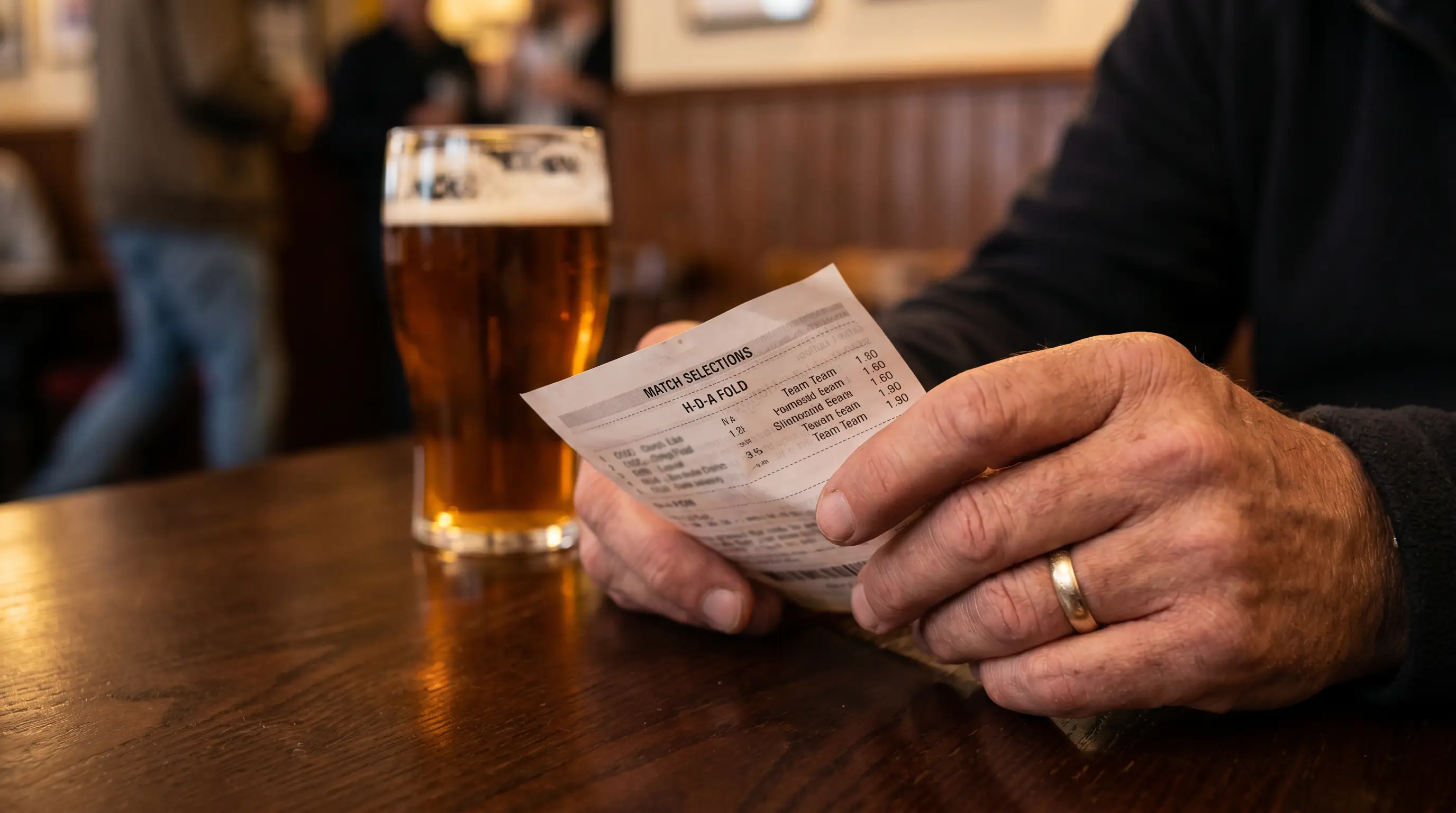
Double chance lets you cover two of the three outcomes in a single bet: home or draw, away or draw, home or away. You're buying safety at the cost of shorter odds. I use double chance rarely, but it has its place in matches where I'm confident one team won't lose but unsure whether they'll win outright.
Draw no bet removes the draw entirely. If the match ends level, your stake is returned. Think of it as a halfway house between the full 1X2 market and the Asian handicap 0 line — functionally they're identical, though the pricing can differ depending on the bookmaker.
Goals Markets: Over/Under, BTTS, Exact Score
Goals markets are where I spend most of my time these days. They strip away the question of who wins and focus purely on how many goals are scored — or whether both teams find the net. That shift in framing opens up analytical angles that result-based bets don't offer.
Over/Under 2.5 Goals — the most commonly traded goals line in UK football. "Over 2.5" wins if three or more goals are scored. "Under 2.5" wins if two or fewer goals are scored. The ".5" ensures there's no push.
The 2.5 line is the standard, but it's far from the only option. You'll find lines at 0.5, 1.5, 3.5, and beyond, plus Asian totals with quarter-goal increments (2.25, 2.75) that split your stake across two lines. The key analytical inputs are the same regardless of the line: average goals scored and conceded by each team, home vs away splits, recent form, and the tactical context of the fixture. A team fighting relegation in the final weeks of the season plays very differently from one with nothing to play for.
BTTS (Both Teams to Score) is a yes-or-no market. Either both sides score at least one goal, or they don't. It's one of the most popular markets in UK football for a simple reason — it keeps you interested for the full ninety minutes regardless of the scoreline. From an analytical perspective, the stats that matter are clean-sheet rates, shots on target conceded, and the defensive vulnerability of each side away from home.
| Market | Example Odds | What You Need |
|---|---|---|
| Over 2.5 Goals | 4/5 | 3 or more goals in the match |
| Under 2.5 Goals | evens | 2 or fewer goals in the match |
| BTTS Yes | 4/6 | Both teams score at least once |
| BTTS No | 11/10 | At least one team fails to score |
| Exact Score 1-1 | 6/1 | Match finishes exactly 1-1 |
Exact score is the high-risk, high-margin corner of the goals market family. You're predicting the precise final scoreline. The bookmaker's overround on correct-score markets is typically 30-50%, far higher than the 5-10% you'll see on match result or over/under. I rarely bet correct scores as standalone selections, but they have a role inside bet builders where the inflated odds can be offset by correlation with other legs.
Bet Builders and Specials
Bet builders changed the game when they launched, and they've only grown since. The concept is straightforward: you combine multiple selections from the same match into a single bet. A team to win, a player to score, over 1.5 goals, and over 9.5 corners — all in one wager, at a combined price.
Bet Builder Example
Selection 1: Home Win — implied probability 55%
Selection 2: Over 1.5 Goals — implied probability 75%
Selection 3: Player A to score anytime — implied probability 35%
If these selections were independent, the combined probability would be 0.55 x 0.75 x 0.35 = 14.4%, suggesting fair decimal odds of about 6.94. But bet builder selections are often correlated — a home win and over 1.5 goals frequently go together — and the bookmaker's pricing engine adjusts for that, typically not in your favour.
The hidden margin in bet builders is real. Because the bookmaker prices each leg individually and then applies a correlation model, the cumulative overround can be significantly higher than on a standard accumulator where legs come from different matches. I treat bet builders as entertainment bets with analytical guardrails — I'll use them when the selections genuinely correlate in ways the pricing model might underweight, but I won't pretend they're a consistent path to value.
Specials — such as "player to score a hat-trick" or "team to win both halves" — fall into a similar category. The odds look attractive because the events are rare, but the margins embedded in those prices are steep. Use them with open eyes.
How Football Betting Odds Work
A few years back, I sat across from someone who'd been betting on football for over a decade and couldn't tell me what 5/1 actually meant in terms of probability. He knew it meant "good odds" and that he'd win five times his stake. But the connection between the price on screen and the bookmaker's view of how likely that outcome was? Blank stare. That gap — between reading odds and understanding them — is where most punters leak money without realising it.
Every set of football betting odds is a statement of probability with a margin baked in. The bookmaker is telling you, through the price, how likely they think an event is to happen — and then charging you a fee for the privilege of betting on it. If you can't convert odds into implied probability, you can't assess whether a bet is worth taking. And if you can't assess that, you're flying blind.
UK bookmakers typically display odds in fractional format — 5/1, 11/8, 4/6 — but decimal and implied probability are far more useful for analysis. The sections below walk through all three formats and the conversion between them, with the kind of worked examples I wish I'd had when I started.
Fractional, Decimal, and Implied Probability
| Format | Example | Calculation | Implied Probability |
|---|---|---|---|
| Fractional | 5/1 | 1 / (5 + 1) | 16.7% |
| Decimal | 6.00 | 1 / 6.00 | 16.7% |
| Fractional | 4/6 | 6 / (4 + 6) | 60.0% |
| Decimal | 1.67 | 1 / 1.67 | 60.0% |
Fractional odds are the UK's native format. The number on the left is your profit, the number on the right is your stake. At 5/1, you profit £5 for every £1 staked — plus you get your £1 back. At 4/6 (odds-on), you profit £4 for every £6 risked. Converting fractional to decimal is simple: divide the first number by the second and add one. So 5/1 becomes (5/1) + 1 = 6.00, and 4/6 becomes (4/6) + 1 = 1.67.
Converting Fractional to Implied Probability
Take fractional odds of 11/4.
Step 1: Add both numbers together. 11 + 4 = 15.
Step 2: Divide the right-hand number (your stake) by the total. 4 / 15 = 0.267.
Step 3: Convert to percentage. 0.267 x 100 = 26.7%.
The bookmaker's implied probability for this outcome is 26.7%. If your own analysis suggests the true probability is higher — say 32% — you've found a potential value bet.

Decimal odds are the European standard and increasingly popular with UK punters who do their own modelling. The decimal figure is your total return per £1 staked, including the stake itself. So 3.50 means you get £3.50 back (£2.50 profit + £1 stake). To find implied probability from decimal odds: divide 1 by the decimal. 1 / 3.50 = 28.6%.
I use decimal odds for everything. They make comparison between bookmakers faster, they simplify accumulator calculations (just multiply the decimals together), and they feed directly into expected value formulas. If you take one practical step from this section, switch your bookmaker account to decimal display.
Spotting Value: When the Price Is Wrong
Here's the question that separates recreational bettors from serious ones: is this bet priced below its true probability? That's value. Not "will this team win?" but "are the odds better than they should be given what I know?"
Expected Value Formula
EV = (Probability of Winning x Net Profit per Bet) - (Probability of Losing x Stake)
Suppose you estimate a team's true win probability at 40%. The bookmaker offers decimal odds of 3.00 (implied probability 33.3%).
EV = (0.40 x £2.00) - (0.60 x £1.00) = £0.80 - £0.60 = +£0.20
A positive expected value of £0.20 per £1 staked. Over hundreds of bets, that edge compounds.

The catch is obvious: you need your own probability estimate to be accurate, or at least more accurate than the market's. That's the hard part, and it's why I always say that value betting is less about finding "tips" and more about building a process that produces reliable probability estimates. The full breakdown of how odds work goes deeper into overround, margin structures, and how to read odds movement across multiple bookmakers.
Football Betting Strategies That Survive the Data
I've tested more football betting strategies than I care to admit. Poisson models, Elo ratings, form-weighted regressions, Fibonacci staking plans, the Pareto principle applied to league specialisation — you name it, I've run it through at least a hundred bets. Most of them broke even or worse. The ones that survived share a common thread: they're grounded in expected value, they're disciplined about staking, and they don't pretend the market is easy to beat.
The UK online gambling market is projected to grow from $9.0 billion in 2025 to $13.2 billion by 2034. That growth means more money, more data, and more sophisticated pricing from bookmakers. The days of finding value by watching Match of the Day and backing your gut feeling are long gone for most markets. What works now is systematic: identify a specific edge, verify it with data, size your bets appropriately, and track everything.
Value-First Approach
Focus on fewer bets where your estimated probability exceeds the bookmaker's implied probability. Requires strong analytical skills and patience. Lower volume, higher expected ROI per bet.
Volume-First Approach
Place more bets across a wider range of markets, accepting a smaller edge per selection. Requires a larger bankroll and rigorous record-keeping. Higher volume, smaller margin, profits from scale.

Neither approach is inherently superior — it depends on your analytical strengths, your bankroll, and how much time you can commit. But both demand discipline. The detailed breakdown of six data-backed strategies walks through each method with worked examples, including line shopping, the Kelly Criterion, and why league specialisation consistently outperforms broad-market dabbling.
Strategy without staking discipline is just opinion. The next section covers how to protect your bankroll while you test and refine your approach.
Bankroll Management: Flat Staking vs Percentage
The fastest way to go broke betting on football isn't picking the wrong team — it's staking too much on any single bet. I learned this the hard way in my second year when a "sure thing" accumulator wiped out three months of careful profit in ninety minutes. Since then, every bet I place follows a staking plan, no exceptions.
Flat Staking: The Simplest Method
Decide on a bankroll — say £500. Set your unit size at 1-2% of that bankroll. At 2%, your standard stake is £10. Every bet is £10, regardless of your confidence level. After 50 bets, win or lose, your risk per bet has remained constant.
Flat staking — betting the same fixed amount on every selection — is what I recommend to anyone starting out. It removes emotion from the staking decision. You'll never double up after a loss or pile in after a win. The downside is that it doesn't account for edge size: a 10% edge bet gets the same stake as a 2% edge bet.
Percentage staking adjusts your bet size as your bankroll grows or shrinks. If you always bet 2% of your current bankroll, a winning streak naturally increases your stakes while a losing streak automatically scales them down. It's a built-in survival mechanism. The more advanced version — the Kelly Criterion — calculates the optimal stake based on your estimated edge and the odds offered. Kelly is mathematically elegant but brutally punishing if your probability estimates are off, which is why most serious bettors use a "fractional Kelly" approach, staking a quarter or half of the Kelly-suggested amount.
Before You Place Any Football Bet
- Is this bet within your unit size? If not, reduce it.
- Have you checked the odds across at least three bookmakers?
- Can you articulate why you believe the true probability differs from the implied probability?
- Are you betting because of analysis, or because of a result you just watched?
- Have you recorded this bet in your tracking log before placing it?
UK Football Leagues and Markets Worth Watching
Not all football leagues are created equal from a betting perspective. The Premier League gets the most coverage, the most liquidity, and the most attention from bookmaker traders — which means the odds are tighter and the edges smaller. The further you move from the spotlight, the more room you find.
Premier League
Highest liquidity, tightest margins, most data available. The benchmark for UK football betting.
EFL Championship
46-game season, frequent managerial changes, and less media coverage. A proven hunting ground for value.
Scottish Premiership
Smaller market with predictable patterns at the top and volatility below. Niche knowledge pays off.
World Cup 2026
The first 48-team tournament: 104 matches across the USA, Canada, and Mexico. New format means new market dynamics.
The 2026 FIFA World Cup is the first in the expanded 48-team format, running 104 matches across three host nations. England are among the pre-tournament favourites at around 6/1, sitting alongside Spain, France, and Brazil in most bookmaker markets. The expanded group stage — with more teams and more matches — creates opportunities in markets like group qualification, top group scorer, and first-half results that are still being priced inefficiently by bookmakers adjusting to the new structure.

I divide my betting activity roughly 60/40 between the Premier League and everything else. The Premier League generates the volume, but the Championship, League One, and cup competitions deliver the edge. If you only bet on Saturday 3pm kick-offs in the top flight, you're competing in the most efficient market in football. That's a choice, but it should be a deliberate one.
Why Lower Leagues Offer More Value
5,669 licensed betting shops remain on UK high streets — and most of the slips written inside them are for football matches that the average punter barely follows. The lower leagues are where local knowledge still matters.
Bookmakers employ squads of analysts for the Premier League. They have access to Opta data, xG models, team news from embedded journalists, and real-time market monitoring. For a League One Tuesday night fixture? The pricing is thinner. Fewer people are watching, fewer sharp bettors are involved, and the lines are set with less precision. That gap between the bookmaker's attention and the reality on the pitch is where value lives.
League specialisation — following one or two lower divisions closely enough to spot mispriced lines — is one of the most consistently profitable approaches I've seen over eight years. It's not glamorous. Nobody posts their Wigan Athletic under-2.5-goals winner on social media. But the margins are real, and they persist because the market structure rewards depth over breadth.
UK Gambling Regulation: What Bettors Need to Know in 2026
If you'd told me five years ago that regulation would be the most important topic in a football betting guide, I'd have shrugged. Now it's the section I spend the most time updating. The regulatory landscape for UK football betting has shifted more in the past eighteen months than in the previous decade, and every change has direct implications for how you bet, where you bet, and what the experience feels like.
The foundation is the Gambling Act 2005, which established the UK Gambling Commission as the licensing authority and made it legal for adults aged 18 and over to bet with licensed operators. That framework hasn't been replaced, but the 2023 White Paper triggered a series of reforms that are now landing: financial risk assessments, tax restructuring, sponsorship restrictions, and stronger enforcement against unlicensed operators.
The Gambling Commission issued 741 cease-and-desist orders in the 2025-26 financial year, reported 397,527 URLs to search engines (266,667 of which were removed), and disrupted 1,134 unlicensed sites. Enforcement is scaling up — but so is the black market.

For bettors, the practical effects are twofold. First, the experience of using a licensed site is changing — identity verification is tighter, deposit monitoring is more active, and financial risk assessments are being piloted across the industry. Second, the economics of the market are shifting because of tax increases that bookmakers will inevitably pass on through tighter odds and less generous promotions.
Financial Risk Assessments: Facts vs Myths
No topic in UK gambling generates more heat and less light than financial risk assessments. I've read the comment sections, the tabloid headlines, the MP letters. The narrative out there is that the government wants to check your payslips before you can place a tenner on the football. The reality, based on the actual pilot data, is very different.
Ian Angus, Director of Policy at the Gambling Commission, put it plainly at the Clarion Payment Providers Summit in May 2026: "Financial Risk Assessments are not affordability checks by another name. The checks we have been piloting will not even attempt to make an assessment of what each customer can afford to gamble." He added that if implemented, the assessments would mean operators "should not require consumers to provide documents to assess financial risk."

The pilot results back this up. Fewer than 3% of active accounts were flagged for any kind of assessment. Of those, 97% passed the check frictionlessly — meaning the bettor never noticed anything happened. Just 0.1% of accounts, one in every thousand, couldn't clear the process automatically. The threshold that triggers an enhanced check is £150 in net deposits over a rolling 30-day period, reduced from £500 in February 2025. The Gambling Commission estimates this affects roughly 20% of online customers.
Angus himself acknowledged the misinformation problem, noting that coverage of FRAs has included a great deal of ill-informed or inaccurate content. My read, having followed this closely since the White Paper, is that FRAs will be a background process for the vast majority of punters — not the intrusive interrogation some have predicted.
Remote Gaming Duty and What It Means for Odds
Remote Gaming Duty rose from 21% to 40% on 1 April 2026 — nearly doubling the tax burden on online casino and gaming operators. A separate remote betting duty of 25% takes effect from April 2027, replacing the previous structure. Horse racing retains a preferential 15% rate.
Your football betting winnings remain tax-free in the UK — that hasn't changed. The bettor doesn't pay; the operator does. But when the operator's tax bill nearly doubles, the money has to come from somewhere. In practice, that means tighter odds, smaller welcome offers, and reduced promotions. If you've noticed your favourite bookmaker trimming its acca boost from 50% to 30%, or quietly widening the overround on midweek Championship matches, tax is part of the reason.
Neal Menashe, CEO of Super Group, captured the industry's concern when he said his company supports reasonable taxation of UK online gaming but relies on the government to ensure that the substantial increase is paired with robust enforcement against non-paying offshore operators. That tension — between taxing the legal market harder and pushing punters toward the unregulated one — is the central policy debate in UK gambling right now, and it directly affects the prices you see on screen every matchday.
Choosing a Licensed Football Betting Site
I've had accounts with more bookmakers than I can count on both hands. Some I still use daily. Others lasted a week before I closed them over poor odds, clunky interfaces, or market coverage that stopped at the Premier League. Choosing where to bet is a genuine decision that affects your bottom line, and it's one that most guides outsource to affiliate rankings instead of helping you think through for yourself.
The non-negotiable starting point is licensing. Every legitimate football betting site operating in the UK holds a licence from the UK Gambling Commission. There are 8,148 licensed gambling premises in the country, including 5,669 betting shops, and the remote sector is similarly tightly controlled. If a site isn't licensed, you have no regulatory protection, no dispute resolution, and no guarantee that your funds are held in segregated accounts.
What to Check Before Opening a Betting Account
- UKGC licence number — visible in the site footer, verifiable on the Commission's public register.
- Football market depth — does the site cover EFL, Scottish, and European leagues, or just the Premier League?
- Odds competitiveness — compare the same market across three or four sites before committing.
- In-play coverage — live markets, speed of settlement, and streaming availability.
- Responsible gambling tools — deposit limits, session alerts, self-exclusion via GamStop.

Beyond licensing, the differentiators that matter are odds quality, market depth (especially for bet builders and in-play), and the responsible gambling tools on offer. I keep multiple accounts active because no single bookmaker consistently offers the best price across every market. Line shopping — checking odds at several bookmakers before placing a bet — is one of the simplest ways to improve your long-term returns, and it costs nothing but a few extra minutes. The full guide to choosing a licensed football betting site covers selection criteria in detail.
Where you bet matters. But when you bet — before kick-off or during the match — opens up an entirely different dimension of the market.
In-Play Football Betting: Speed, Risk, and Opportunity
The ball hits the back of the net and the odds flip in seconds. That's the reality of in-play football betting — and it's the fastest-growing segment of the UK market. Six percent of all British adults bet on live football, rising to 9% among men, making it the most popular live betting format in the country.
In-play betting lets you place wagers after kick-off, on markets that update in real time: next goal, match result, total goals, corners, cards, and dozens more. The appeal is obvious — you can watch the game, read the flow of play, and react to what you're seeing. An early red card, a tactical substitution, a dominant spell of possession that hasn't produced a goal yet — all of these create in-play situations where the odds might not have caught up with reality.
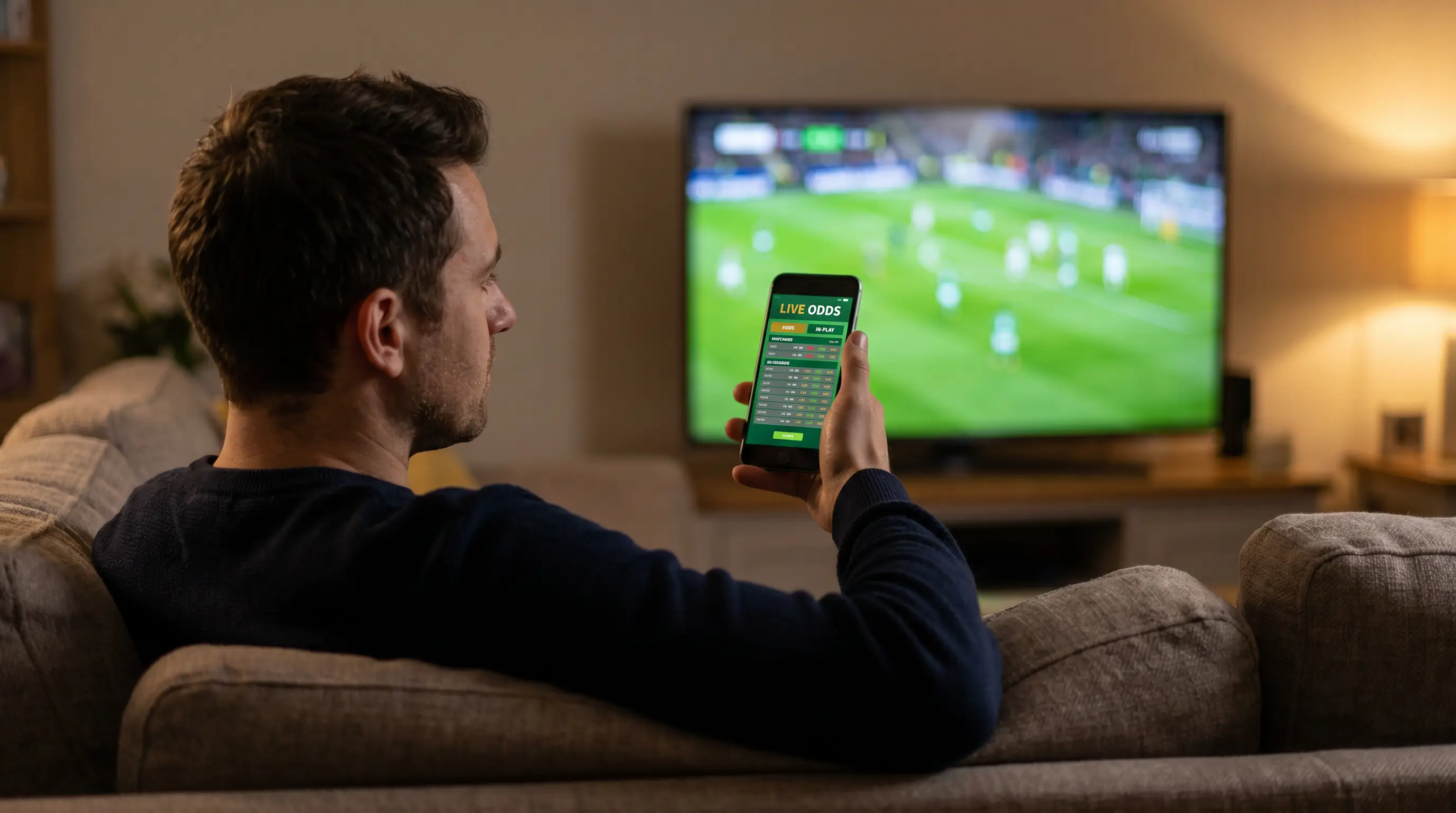
But in-play is also where discipline breaks down fastest. The speed of the market, the emotional pull of a game you're watching, and the constant availability of new markets create a perfect environment for impulsive betting. I've seen experienced punters blow through their weekly bankroll in a single half of football because the in-play interface made it too easy to chase a bad first bet with a worse second one.
The mechanics of live betting — market suspension during key events, latency between what you see on screen and what the bookmaker's feed shows, and the reduced time for analysis — all tilt the edge further toward the operator. That doesn't mean in-play is a losing proposition for everyone, but it demands a different process than pre-match betting. You need pre-set rules, predefined scenarios, and the self-awareness to walk away when the game stops matching your thesis. The dedicated in-play guide covers specific markets, timing strategies, and the data behind live betting behaviour in the UK.
Responsible Gambling: Data, Not Slogans
Most betting guides tack a "gamble responsibly" line at the bottom and move on. I'm not going to do that, because the data is too serious to treat as a footnote. 2.7% of UK adults score 8 or above on the Problem Gambling Severity Index — that's the threshold for problem gambling. Another 3.1% fall into the moderate-risk category. Among 18-24 year olds, the picture is worse: 5.3% hit the problem gambling threshold, the highest rate of any age group.
These aren't abstract numbers. Among survey respondents who gamble, 12.2% reported suicidal thoughts or attempts in the past year, and 5.2% connected those experiences partly or entirely to their gambling. Football is the biggest single category of sports betting in the UK, which means football betting is the primary channel through which a significant number of people develop harmful gambling patterns.
Grainne Hurst, CEO of the Betting and Gaming Council, has argued that betting and gaming is a genuinely enjoyable experience for 22 million people every month in the UK, and the vast majority do so safely and responsibly. That's true. But "the vast majority" still leaves hundreds of thousands of people in serious difficulty, and the tools available to protect them — deposit limits, session alerts, reality checks, and self-exclusion through GamStop — only work if people know about them and use them proactively.
If you or someone you know is struggling with gambling, GambleAware offers free information and support. The National Gambling Helpline is available 24 hours a day on 0808 8020 133. GamStop allows you to self-exclude from all UKGC-licensed online gambling sites for a period of six months, one year, or five years.

I include this section not as a disclaimer but as a core part of the guide. If you're betting on football, your first line of defence is knowing the risk, setting limits before you start, and having the honesty to reassess if the experience stops being enjoyable. Data-driven betting starts with data about yourself.
The Black Market Problem: £17 Billion Outside Regulation
There's a parallel football betting market in the UK that most guides pretend doesn't exist. An estimated 1.5 million British punters already place bets with unlicensed operators, staking roughly £10 billion a year outside UK regulation. And it's growing fast.
H2 Gambling Capital, one of the industry's most-cited research firms, forecasts that stakes on illegal operators in the UK will rise from £17 billion in 2026 to £33 billion by 2028. At that rate, one in every five pounds wagered online would be going to an operator with no UK licence, no obligation to protect customer funds, and no accountability to the Gambling Commission.
Grainne Hurst didn't mince words about the trajectory, calling it a wake-up call and warning that the black market is not a distant threat but a fast-growing, increasingly visible one attracting billions in stakes from British customers. Her broader argument — that making the regulated market less competitive through higher taxes or intrusive checks will push customers toward the black market rather than away from gambling altogether — is backed by precedent. In the Netherlands, after the government tightened online gambling restrictions, searches for illegal gambling sites surged from 200,000 in 2022 to over a million by March 2025.
The risks for bettors using unlicensed sites are tangible: no guaranteed payout, no access to the Gambling Commission's dispute resolution process, no GamStop self-exclusion coverage, and no assurance that the operator meets anti-money-laundering or responsible gambling standards. If something goes wrong, you have no recourse.
For anyone reading this guide, the message is straightforward — stick with UKGC-licensed operators. The protections exist for a reason, and they're the reason this market works at all.
FAQ
How do football betting odds work in the UK?
Football betting odds represent the bookmaker's assessment of how likely an outcome is, expressed as a price that includes their profit margin. In the UK, odds are most commonly displayed in fractional format — 5/1 means you profit £5 for every £1 staked. To find the implied probability, divide the right-hand number by the sum of both numbers: for 5/1, that's 1/(5+1) = 16.7%. The sum of implied probabilities across all outcomes in a market always exceeds 100% — the excess is the bookmaker's overround. Switching your account display to decimal odds makes comparisons and calculations significantly easier.
What types of football bets can I place?
UK bookmakers offer dozens of football markets. The main categories are result-based bets (match result 1X2, double chance, draw no bet), goals markets (over/under, both teams to score, exact score), and combination bets (accumulators across multiple matches, bet builders within a single match). Beyond these, you'll find player-specific markets like anytime goalscorer, cards and corners markets, and outright tournament betting such as league winner or top scorer. The range expands significantly for in-play betting, where live markets update throughout the match.
Is football betting legal in the UK?
Football betting is fully legal in the UK for adults aged 18 and over, provided you use an operator licensed by the UK Gambling Commission. The legal framework is the Gambling Act 2005, supplemented by ongoing reforms from the 2023 White Paper. Using an unlicensed operator is not a criminal offence for the bettor, but it removes all regulatory protections — you have no recourse if the operator fails to pay out, and no access to dispute resolution or self-exclusion tools like GamStop.
What are the UK's financial risk assessments for betting?
Financial risk assessments are a new layer of monitoring being piloted by UKGC-licensed operators. They are triggered when a customer's net deposits exceed £150 in a rolling 30-day period. Contrary to widespread misconception, they are not affordability checks and do not require you to submit payslips or bank statements. The Gambling Commission's pilot found that fewer than 3% of accounts were flagged, 97% of those passed the check frictionlessly, and only 0.1% could not clear the process automatically.
How do I manage my bankroll for football betting?
Start by setting aside a dedicated betting bank — money you can afford to lose entirely without affecting your daily life. Set your unit size at 1-2% of that bankroll. Flat staking, where every bet is the same amount regardless of confidence, is the simplest and most effective method for most bettors. Percentage staking adjusts your bet size as your bankroll changes. The Kelly Criterion calculates an optimal stake based on your estimated edge, but it's unforgiving if your probability estimates are inaccurate — most serious bettors use a fractional Kelly approach instead.
What are accumulator bets and are they worth it?
An accumulator combines multiple selections into a single bet where all legs must win for the bet to pay out. The appeal is the multiplied odds — a four-fold at 2.00 per leg returns 16.00 — but the implied probability drops rapidly. A four-fold with 50% implied probability per leg has just a 6.25% chance of winning. Accumulators can offer genuine value when the individual selections are themselves value bets, but the compounding overround across multiple legs means the bookmaker's edge grows with every selection added. The full accumulator guide breaks down the maths and the most common traps.
Are my football betting winnings taxed in the UK?
No. Football betting winnings are completely tax-free for UK bettors. You do not need to declare them on your tax return. The tax burden falls on the operator, not the customer. However, the Remote Gaming Duty was increased from 21% to 40% in April 2026, and a new 25% remote betting duty takes effect from April 2027. These increases affect bettors indirectly — operators absorb the higher costs by offering tighter odds and less generous promotions.
