
 Available in US
Content

Asian Handicaps Eliminate the Draw — and That Changes Everything
The first time I encountered a -0.25 Asian handicap line, I stared at it for a full minute trying to work out what would happen if the match finished level. The concept of half your stake winning and half being refunded felt alien after years of 1X2 betting. Now, Asian handicaps are my most-used market. They offer tighter margins, cleaner risk profiles, and a logic that, once understood, makes the traditional three-way match result market feel crude by comparison.
Football generates around 1.3 billion pounds in remote gross gambling yield in the UK annually, and a growing share of that comes from Asian handicap markets. The total remote betting GGY sits at approximately 2.6 billion pounds. Asian handicaps were developed in East Asian betting markets where the draw was seen as an unsatisfying outcome for bettors, and the solution — handicapping one team to eliminate the draw — has spread to every major UK-facing operator. The Betting and Gaming Council’s Grainne Hurst has noted that betting is a genuinely enjoyable experience for 22 million people in the UK each month. Asian handicaps make that experience more precise for anyone willing to learn the mechanics.
How Asian Handicap Lines Work: 0, -0.5, -0.25, -0.75
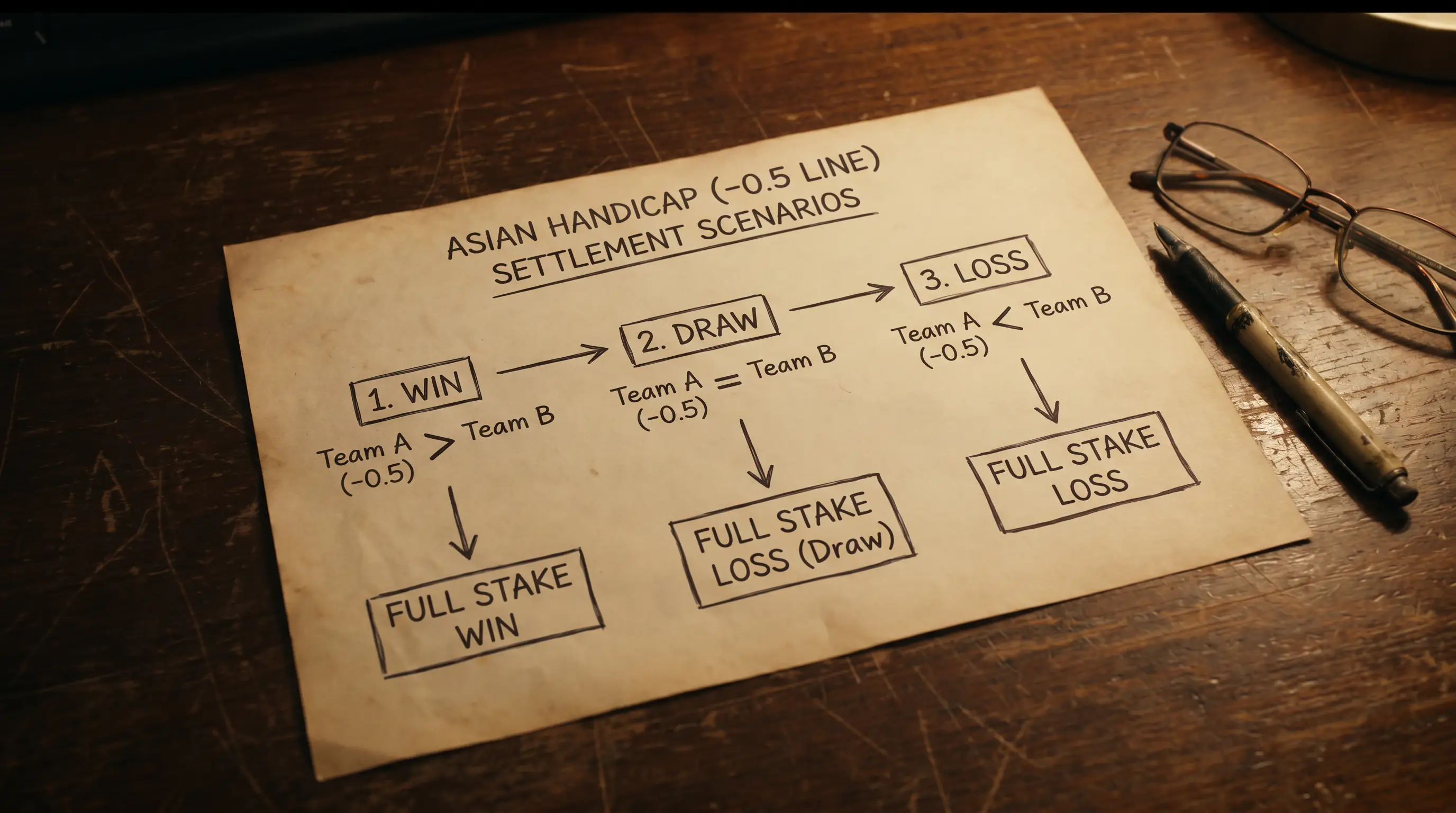
An Asian handicap applies a goal advantage or disadvantage to one team before the match starts. The simplest form is the -0.5 line. If you back a team at -0.5, they need to win the match for your bet to succeed. A draw or a loss means you lose. It is equivalent to backing the team to win on the 1X2 market, but the odds are typically slightly better because the bookmaker’s overround is lower in Asian handicap markets.
The 0 line — also called “level ball” — functions identically to Draw No Bet. Back a team at 0, and your stake is refunded if the match draws. They win, you win. They lose, you lose. No dead heat, no complication.
The -1.0 line means your team starts with a one-goal deficit. They need to win by two or more for your bet to win. If they win by exactly one, the match is level on the handicap and your stake is refunded. If they draw or lose the actual match, you lose the bet.
So far, straightforward. The complexity — and the value — arrives with quarter lines.
Quarter Lines and Split Stakes Explained
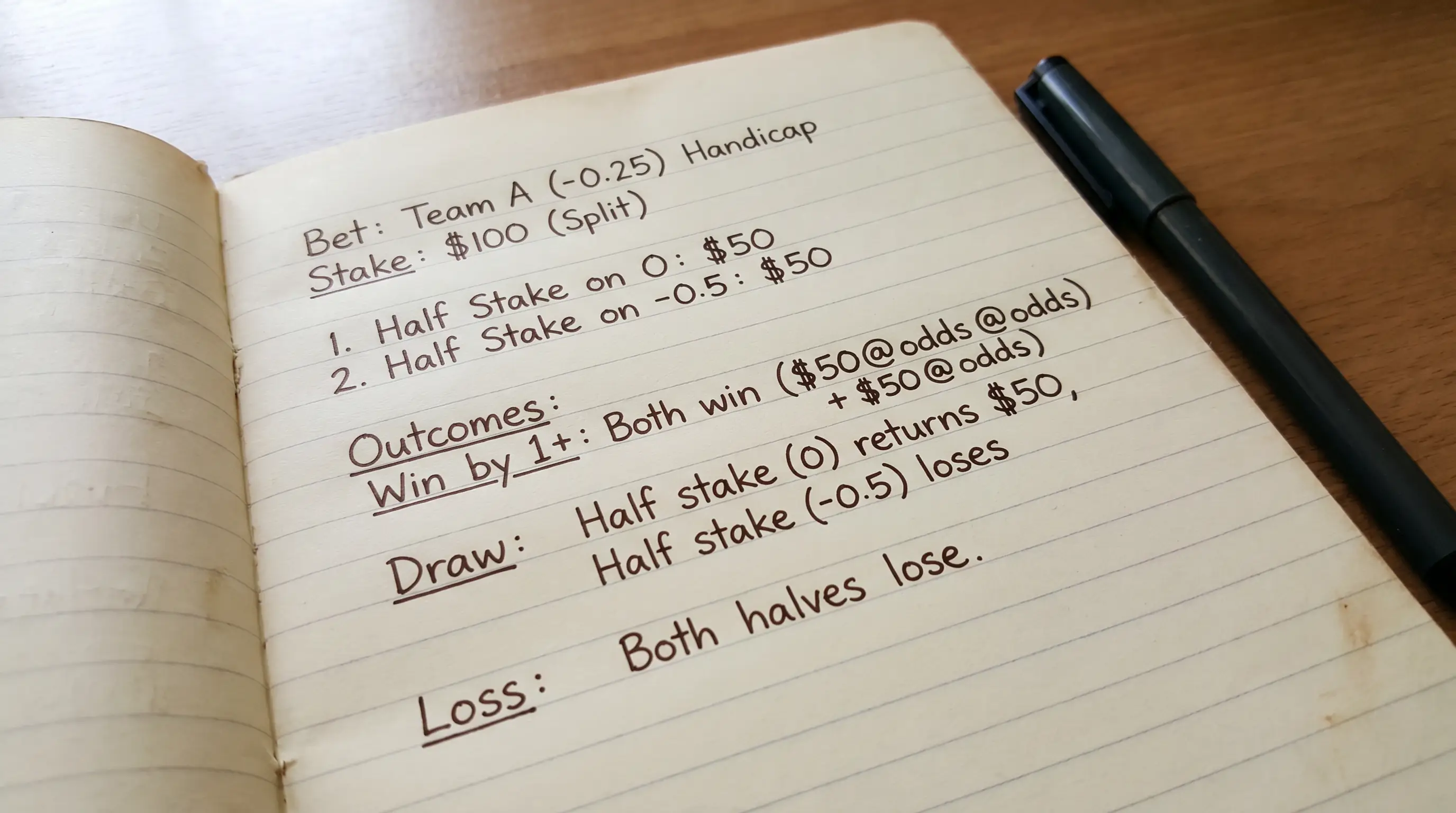
A -0.25 line is not a single bet. It is two bets of equal size: half your stake on -0 (level ball) and half on -0.5. Think of -0.25 as sitting exactly between 0 and -0.5.
If you place 20 pounds on a team at -0.25 and they win, both halves win. You collect on the 0 line and the -0.5 line. Full payout. If the match draws, the 0 half is refunded and the -0.5 half loses. You get back 10 pounds and lose 10 pounds — a half-loss. If they lose, both halves lose. Full loss.
The -0.75 line works on the same principle: half your stake on -0.5 and half on -1.0. If your team wins by two or more, both halves win. If they win by exactly one, the -0.5 half wins and the -1.0 half is refunded. If the match draws or your team loses, both halves lose.
I find quarter lines most useful in matches where the expected goal difference is tight. If my model says a home side should win by 0.7 goals on average, a -0.5 line feels slightly too aggressive and a 0 line feels too conservative. The -0.25 splits the difference and gives me a bet that reflects the tightness of the contest. The granularity is the whole point — it lets you match your bet to your analysis with more precision than the blunt 1X2 market allows.
The positive handicap lines work identically but in reverse. If you back an underdog at +0.75, your stake splits between +0.5 and +1.0. A draw wins both halves. A loss by exactly one goal loses the +0.5 half but refunds the +1.0 half. A loss by two or more loses everything. Positive handicaps are the sharpest tool for backing underdogs you expect to compete closely without necessarily winning — a profile that fits a significant number of Premier League away fixtures.

One common mistake is treating quarter lines as confusing. They are not — they are simply two bets at adjacent whole or half-goal lines. Once you internalise the split-stake concept, reading any Asian handicap line becomes automatic. I recommend placing a few small bets on quarter lines and manually tracking the settlement until the mechanics feel intuitive. The learning curve is steep but short.
Asian Handicap vs 1X2: When to Use Each
The 1X2 market has three outcomes and wider margins. The Asian handicap market has two outcomes (win or lose, with refunds replacing draws) and tighter margins. For any match where you have a directional opinion — you think one team will win — the Asian handicap almost always offers better value than the equivalent 1X2 bet.
I use 1X2 in two specific situations. First, when I want to back the draw — Asian handicaps eliminate the draw, so the 1X2 market is the only option for a draw-specific position. Second, when the match involves a heavy favourite where the 1X2 home win price is very short (below 1.40) and the equivalent Asian handicap line is -1.5 or deeper, which introduces a risk profile I am not comfortable with.

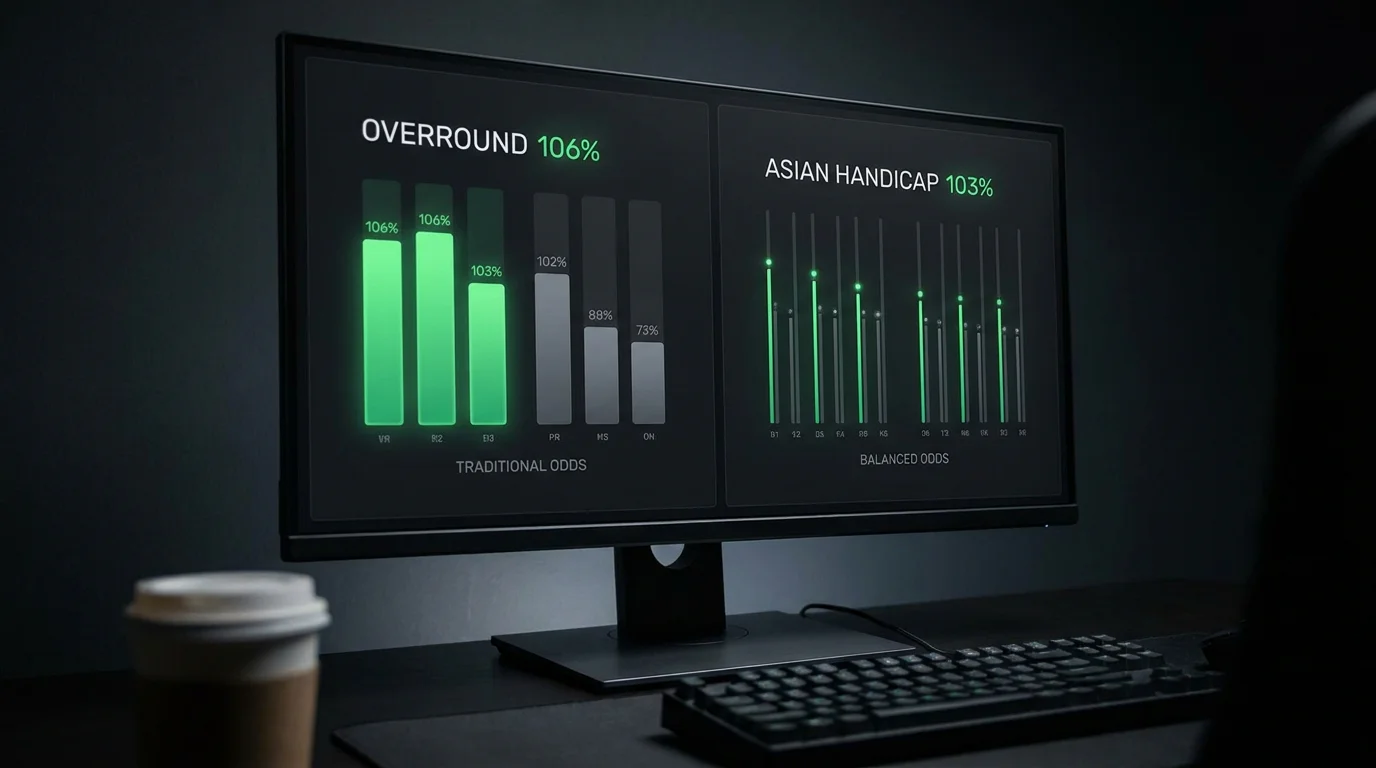
For everything else, I default to Asian handicaps. The margin saving alone is worth the switch. On a typical Premier League fixture, the 1X2 overround might be 106%, while the Asian handicap overround on the same match is 103-104%. Over 200 bets in a season, that 2-3% margin difference is the difference between a marginal loss and a marginal profit — before even accounting for selection quality. For a detailed explanation of how those margins work and what overround means for your returns, the odds explained guide breaks down the arithmetic step by step.
What does -0.25 mean in Asian handicap football betting?
A -0.25 Asian handicap splits your stake into two equal bets: half on the 0 line (level ball) and half on -0.5. If your team wins, both halves pay out. If the match draws, half your stake is refunded (the 0 line) and half loses (the -0.5 line), giving you a half-loss overall. If your team loses, both halves lose.
Can I combine Asian handicap bets in an accumulator?
Yes, most UK operators allow Asian handicap selections in accumulators. However, the settlement rules for quarter-line bets in accumulators can be complex — a half-win or half-loss on one leg affects the overall return calculation. Make sure you understand how your operator settles Asian handicap accumulators before combining multiple quarter-line selections.
