
 Available in US
Content
- Accumulators Are the Most Popular Bet in UK Football — and the Least Understood
- How Accumulator Bets Work: The Maths Behind Multiples
- Doubles, Trebles, Four-Folds, and Lucky 15s
- When Accumulators Offer Genuine Value
- Acca Insurance and Acca Boosts: What the Terms Really Mean
- Building a Smarter Accumulator: Selection Process
- The Accumulator Trap: Common Mistakes and How to Avoid Them
- Accumulators Are a Tool, Not a Strategy
- FAQ

Accumulators Are the Most Popular Bet in UK Football — and the Least Understood
Last January, a mate of mine landed a seven-fold accumulator on a Saturday of Premier League football. Seven results, all correct, turning £5 into just over £800. He talked about it for weeks. What he didn’t mention — and what I had to pull out of him over a pint — was that he’d been placing seven-fold accumulators every Saturday for the better part of two years. At £5 a week, that’s roughly £500 in stakes before his big win. His net profit on accumulators across those two years was about £300 — a return he could have achieved far more reliably with disciplined singles.
That story captures the accumulator in miniature. The payout is thrilling. The maths is brutal. Football accumulators are the most popular bet type in the UK market, driving a disproportionate share of the £1.3 billion in GGY that remote operators collect from football each year. Bookmakers love them because the margin compounds with every leg. Bettors love them because a small stake can produce a life-changing return. Both things are true simultaneously, and understanding the tension between them is the key to approaching accas with your eyes open.
This guide doesn’t tell you accumulators are bad. They’re not. There are specific circumstances where a well-constructed acca offers genuine value. But those circumstances are narrower than the betting industry’s marketing suggests, and 5.8% of the UK population betting on football deserve to understand the maths before they fill a ten-fold coupon every weekend.
How Accumulator Bets Work: The Maths Behind Multiples
An accumulator combines multiple selections into a single bet. Every selection must win for the bet to pay out. The combined odds are calculated by multiplying the decimal odds of each leg together. That multiplication is both the appeal and the problem.
Take a simple four-fold. You pick four teams to win their matches, each priced at 1.80 in decimal odds. The combined odds: 1.80 x 1.80 x 1.80 x 1.80 = 10.50. A £10 stake returns £105 if all four win. The same four bets placed as singles, at £2.50 each (totalling the same £10 stake), would require all four to win to generate a similar total return — but if three win and one loses, your singles would return £13.50 (three wins at 1.80 x £2.50 = £4.50 each, minus the one £2.50 loss). The accumulator returns nothing.
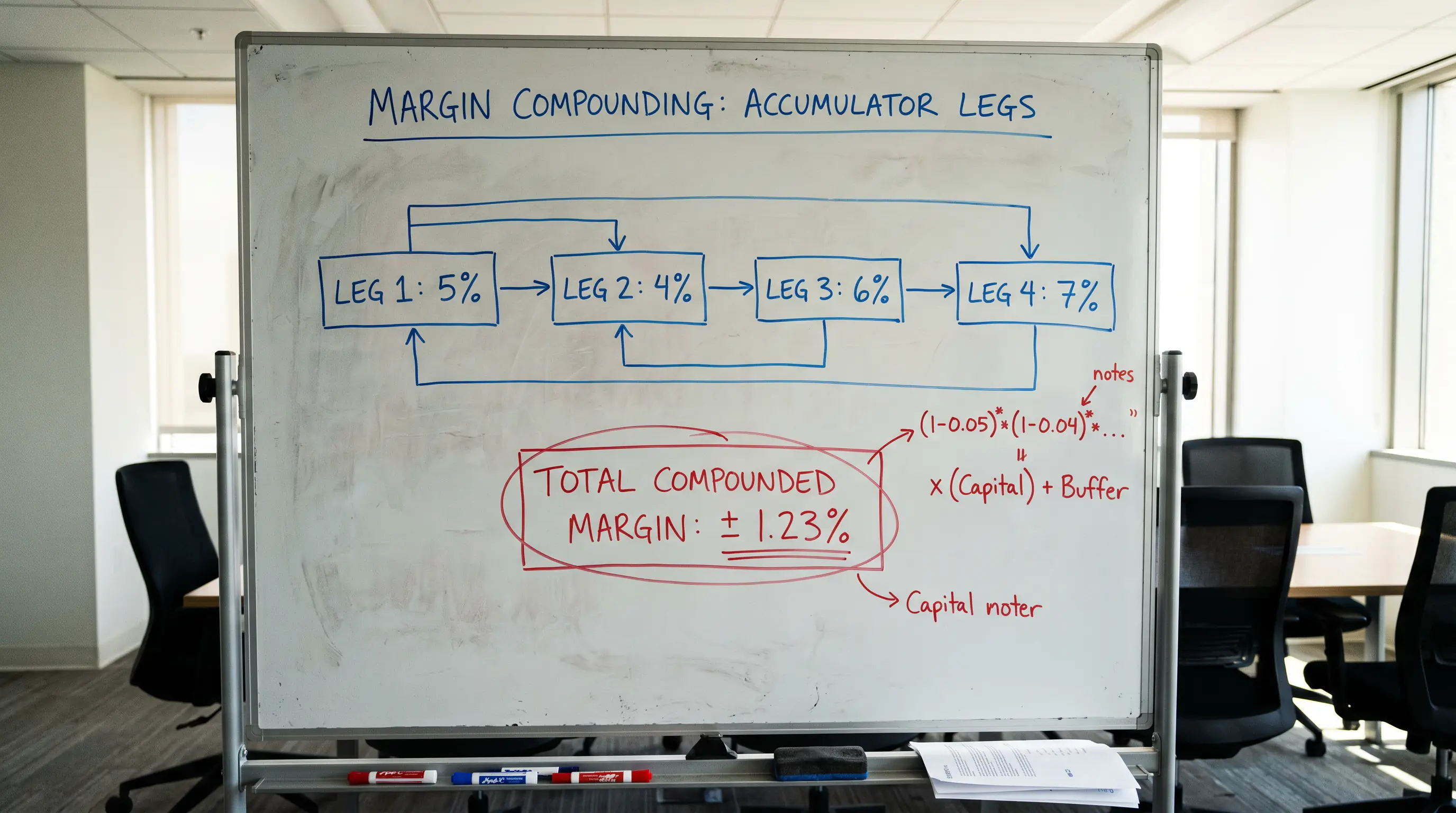
That’s the core trade-off. Accumulators concentrate risk for amplified reward. Singles spread risk for more consistent, smaller returns. The mathematical reason bookmakers profit more from accumulators is margin compounding. Each individual leg carries a bookmaker margin, typically 3-6% on a match result market. When you multiply the odds across four legs, you’re also multiplying the margin. A 5% margin per leg in a four-fold compounds to roughly 18.5% combined margin. In a ten-fold, the effective margin can exceed 40%. You’re paying dramatically more for the right to combine your selections than you would placing them individually.
Here’s the number that matters most: for a four-fold at even-money prices (2.00 each), a fair market with zero margin would give you combined odds of 16.00. With typical bookmaker margins, you’ll actually get somewhere around 13.00-14.00. That gap — 16.00 versus 13.50, say — is the cost of the accumulator. It comes straight from your expected return, and it grows with every leg you add.
None of this means accumulators can’t win. They can, and they do — spectacularly, sometimes. But the expected value of every additional leg is negative unless each individual selection has positive expected value by a margin that exceeds the bookmaker’s compounding edge. That’s a high bar. Meeting it once in a four-fold is hard. Meeting it in all four legs simultaneously is harder. Meeting it in ten legs is, for almost everyone, unrealistic.
Doubles, Trebles, Four-Folds, and Lucky 15s
Not all accumulators are created equal, and the terminology can obscure important differences in structure and risk.
A double is the simplest multiple: two selections, both must win. The margin compounding is minimal — roughly double the single-leg margin — and the payout multiplier is modest. Doubles are the most mathematically defensible type of accumulator because the cost of combining is low relative to the potential benefit. If you have two selections where you believe you’ve found genuine value, a double captures more upside than two singles while adding only a small margin penalty.
A treble adds a third leg, and a four-fold adds a fourth. Each additional selection increases both the potential payout and the compounded margin. The sweet spot, if there is one, lies between two and four legs. Beyond four, the margin compounding becomes severe enough that the entertainment value of the bet needs to be weighed honestly against its mathematical expectation.
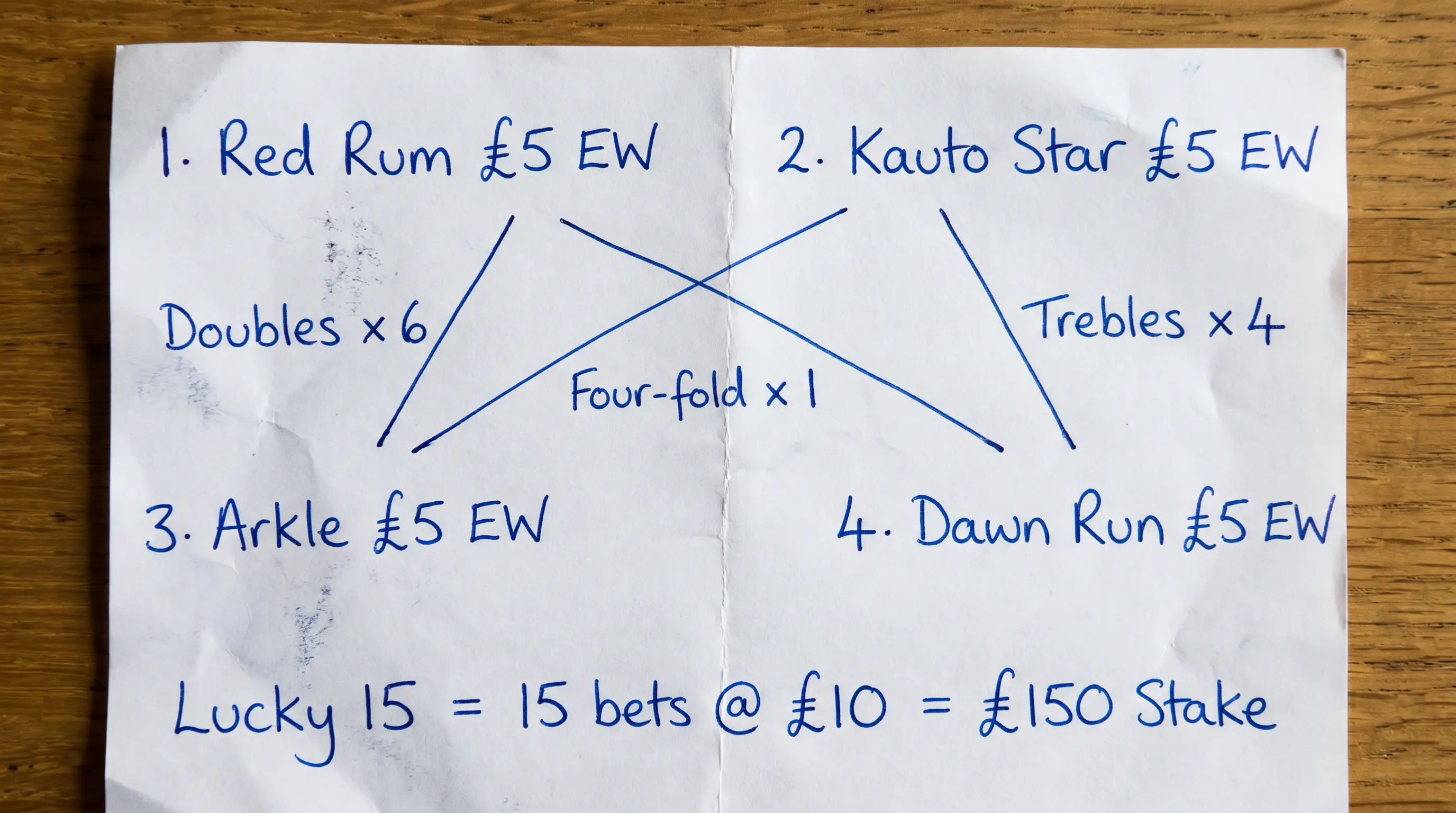
Full cover bets — Trixie, Yankee, Lucky 15, Lucky 31 — are a different animal entirely. A Trixie covers three selections in four bets: three doubles and one treble. A Yankee covers four selections in eleven bets: six doubles, four trebles, and one four-fold. A Lucky 15 adds four singles to the Yankee’s eleven, for fifteen bets total. These structures give you returns even if not every selection wins, which addresses the all-or-nothing problem of a standard accumulator. The trade-off is stake: a Lucky 15 at £1 per line costs £15. A Yankee at £1 per line costs £11. You’re spreading the risk, but you’re also multiplying your outlay.
For football, the most common accumulator type is the straightforward multi-fold: four, five, six, or more teams to win, all on a single coupon. The weekend acca — picking winners across the Saturday 3pm kick-offs — is practically a cultural tradition in UK football betting. Understanding the types available, and especially the full-cover alternatives, gives you options beyond the standard “all must win” structure.
When Accumulators Offer Genuine Value
So when do accumulators genuinely make sense? I’ve spent years trying to identify the narrow conditions under which the acca format offers something you can’t get from singles, and the honest answer is: rarely, but not never.
The first scenario is correlated outcomes. Standard accumulators assume each leg is independent — the result of Match A doesn’t affect the result of Match B. In a standard multi-fold across different fixtures, that’s broadly true. But in some situations, outcomes are positively correlated. If you believe a specific weather system will affect all three Saturday afternoon matches at grounds in the north-west, and your assessment is that the weather favours under 2.5 goals in all three, the correlation between those outcomes means a treble captures more of your “view” than three singles would. The bookmaker prices each leg independently, but the outcomes are linked by a factor the pricing doesn’t fully account for.
The second scenario is small-stakes entertainment with defined risk. A £2 ten-fold on a Saturday afternoon, placed with the understanding that it’s entertainment rather than investment, carries a maximum downside of £2. The total remote betting GGY of £2.6 billion includes a healthy portion of exactly this kind of recreational acca. As long as the bettor understands the expected value is deeply negative and treats the stake as the cost of entertainment — no different from buying a lottery ticket — there’s nothing wrong with it. The problem arises when the £2 becomes £20, or when the weekly acca becomes a daily one, or when the accumulator is the bettor’s primary strategy rather than an occasional side bet.
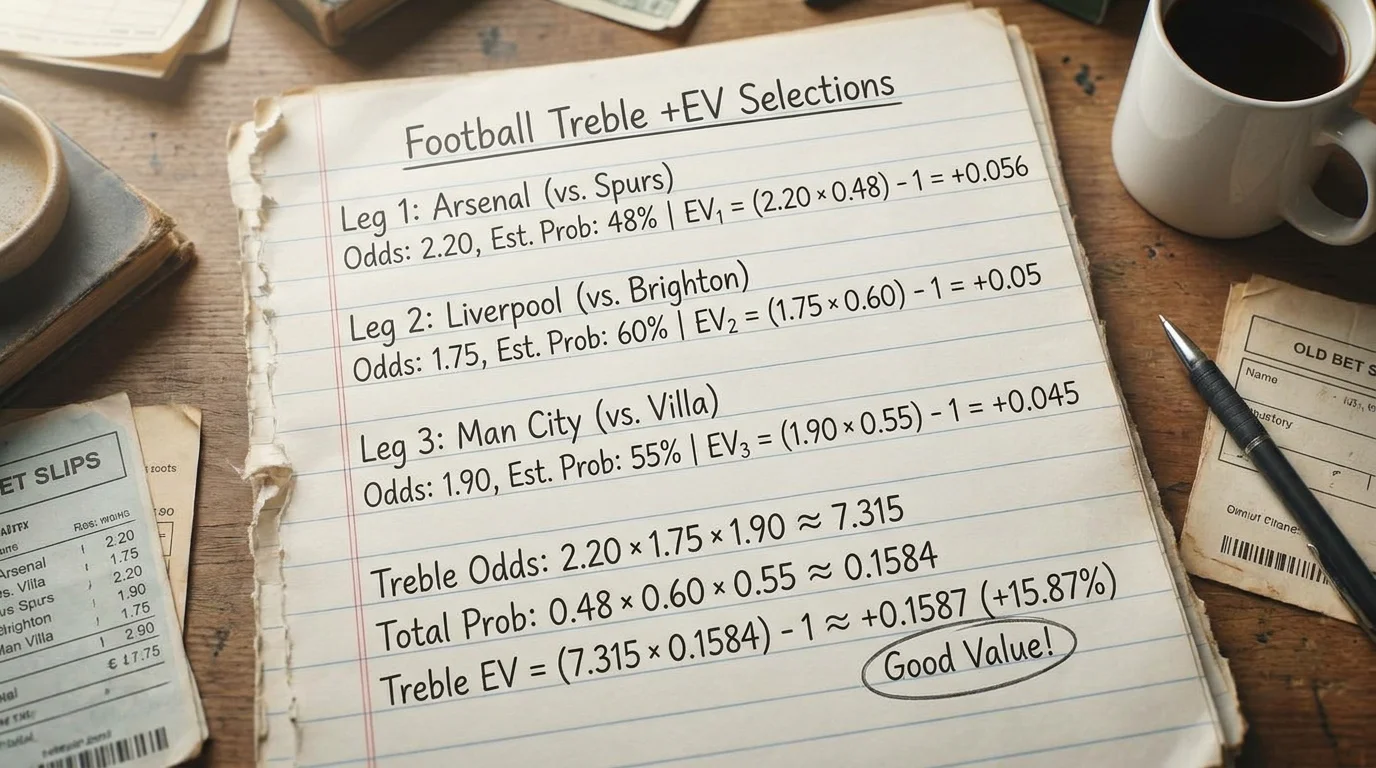
The third, and most analytically interesting, scenario is when every leg in the accumulator independently offers positive expected value. If your analysis identifies four value bets — each with a positive EV of, say, 5-8% — combining them in a four-fold compounds that edge. Your expected return on the four-fold is higher than on any individual single, because you’re multiplying positive-EV prices together. This is the only circumstance in which an accumulator is mathematically superior to singles on a per-pound basis. The catch, as I noted earlier, is that genuinely finding four positive-EV selections on the same coupon requires a level of analytical skill and market awareness that most bettors — myself included on most weekends — don’t consistently achieve.
A worked example makes the distinction concrete. Say you’ve identified three matches where your estimated probability exceeds the implied probability by around 5% each. Match A: you estimate 55% win probability, odds offer 2.00 (implied 50%). Match B: you estimate 40% win probability, odds offer 2.80 (implied 35.7%). Match C: you estimate 65% win probability, odds offer 1.70 (implied 58.8%). Each leg has positive EV. The treble at combined odds of 9.52 has a “true” probability (based on your estimates) of 0.55 x 0.40 x 0.65 = 14.3%. The implied probability at 9.52 is 10.5%. The gap between 14.3% and 10.5% is your edge on the treble, and it’s wider than the edge on any individual leg. That’s the accumulator working for you. But the moment one of those legs is a “I think they’ll probably win” rather than a rigorously estimated positive-EV selection, the entire treble’s expected value degrades.
Acca Insurance and Acca Boosts: What the Terms Really Mean
Acca insurance and acca boosts are the two promotional tools bookmakers use to drive accumulator volume. Both sound generous. Neither is quite what it appears.
Acca insurance typically works like this: if one leg of your accumulator (usually five-fold or higher) lets you down, you get your stake back as a free bet. The key words are “free bet” — not cash. A free bet at most operators means “stake not returned,” so a £10 free bet that wins at 3.00 pays you £20 in profit, not £30. The insurance also has conditions: minimum odds per leg (usually 1.20 or higher), minimum number of legs (often five), and the requirement that only one leg can lose. If two legs lose, the insurance doesn’t apply. Given that the probability of exactly one leg failing in a five-fold is specific and not especially high, the insurance triggers less often than bettors assume. It’s a real benefit — but its expected value is lower than the headline “money back if one leg loses” implies.
Acca boosts add a percentage to your accumulator winnings. A 10% acca boost on a five-fold that pays £100 gives you an extra £10. Some operators offer escalating boosts: 5% on a double, 10% on a treble, up to 50% or more on a ten-fold. The maths here is worth examining. A 50% boost on a ten-fold sounds enormous, but the ten-fold itself has such a low probability of landing that the expected value of the boost is tiny. You’d need to win the ten-fold to benefit, and the odds of that are typically less than 1%. The boost on a double or treble is smaller in percentage terms but far more likely to actually pay out, making it more valuable in expected terms. New account registrations across remote operators totalled 34.0 million in 2024-25, and promotions like these are a significant driver of that volume.
Neither acca insurance nor acca boosts turn a negative-EV accumulator into a positive one. They reduce the margin you’re paying, which is worthwhile, but they don’t eliminate it. As Neal Menashe, CEO of Super Group, put it when responding to the Remote Gaming Duty increase: operators “rely on the government to ensure that today’s very substantial increase should be paired with robust and strict enforcement against non-paying offshore operators.” The promotional landscape is shifting as operators absorb higher costs, and the generosity of acca boosts and insurance offers may well tighten in the coming years. Treat them as a discount, not as a reason to place accumulators you wouldn’t otherwise consider.

Building a Smarter Accumulator: Selection Process
If you’re going to place an accumulator — and I do, occasionally, when the conditions are right — the selection process should be more rigorous than for a single, not less. Each leg you add is a potential point of failure, and every selection needs to earn its place on the coupon.
Start by analysing each match independently. Six percent of UK adults bet on live football and many more bet pre-match, but the majority of acca bettors don’t give each leg the same analytical attention they’d give a standalone bet. They pick four or five “likely winners” based on league position or recent form and combine them. That’s not analysis. That’s hope with a multiplier attached.
Each leg should pass the same test a single bet would: does my probability estimate for this outcome exceed the implied probability of the odds? If the answer is no for any leg, that leg comes off the coupon. A four-fold with three value selections and one filler selection is worse than a treble with three value selections, because the filler leg reduces the overall expected value while adding another point of failure.
Consider the market mix. A five-fold of “favourite to win” selections at odds of 1.30-1.50 each is the classic Saturday acca. The combined odds might look attractive — 3.71 to 7.59 depending on the specific prices — but every leg is an odds-on favourite where the bookmaker’s margin is proportionally highest. Mixing in a selection from a different market (Over 2.5 Goals in a match you’ve analysed for goal potential, or BTTS Yes where the defensive stats support it) can improve the overall profile of the accumulator by adding legs where your edge is clearest, not just where the favourite seems “safest.”
Keep the number of legs low. Doubles and trebles are where the accumulator format works hardest for you, because the margin compounding is manageable and the probability of all legs landing is realistic. Every leg beyond the third or fourth is an exponential step toward improbability. I rarely go beyond four legs, and when I do, it’s because each selection independently met my value criteria — not because I wanted a bigger price.

The Accumulator Trap: Common Mistakes and How to Avoid Them
The accumulator trap is simple: you remember the wins and forget the losses. Psychologists call it availability bias — the vivid memory of a five-fold landing at 25/1 is more psychologically salient than the twenty-five times the same type of bet lost. Over two years of tracking my own accumulator bets, my ROI on accas was consistently lower than my ROI on singles, despite the occasional spectacular win. The spectacular wins were real. They were also insufficient to compensate for the steady bleed of losing accas.
The most common mistakes: adding legs for the sake of a bigger price (“I’ll throw in that Barcelona match too — they’ll definitely win”); failing to check the combined overround you’re facing; treating accumulators as a primary betting strategy rather than an occasional supplement; and chasing acca losses with bigger or more ambitious accas. That last one is particularly dangerous. When you lose a ten-fold by one leg, the temptation to “go again” with a similar coupon is powerful — and it’s exactly the behaviour that 2.7% of UK adults who score as problem gamblers on the PGSI scale struggle to control.
If accumulators are a regular part of your betting, track them separately from your singles. Calculate the ROI honestly. Compare it to what you’d have achieved placing the same selections as individual bets. If the acca ROI is worse — and for most bettors, it will be — that’s the data telling you to shift your volume toward singles and reserve accumulators for the rare occasions when every leg genuinely represents value.

Accumulators Are a Tool, Not a Strategy
The accumulator is the most marketed, most placed, and most misunderstood bet in UK football. It’s a tool with a specific, narrow purpose: amplifying returns when you have multiple positive-EV selections. Outside that purpose, it’s entertainment — enjoyable, exciting, and mathematically stacked against you. There’s nothing wrong with placing one for fun, the same way there’s nothing wrong with buying a raffle ticket. But if you treat the Saturday acca as your primary route to profit, the maths will catch up with you, and the bookmakers’ £1.3 billion in football GGY is the proof.
FAQ
How many selections should a football accumulator have?
The fewer the better, mathematically. Doubles and trebles keep margin compounding manageable and have a realistic probability of landing. Every leg beyond the third compounds the bookmaker’s margin and reduces your chances exponentially. If you have four genuine value selections, a four-fold is reasonable. Beyond that, the entertainment value may be real, but the expected return drops sharply with each additional leg.
What happens if one leg of my accumulator is void?
If one leg of your accumulator is voided — typically because the match is postponed or abandoned, or the market is settled as void under the operator’s rules — that leg is removed and the accumulator is recalculated with the remaining legs. A five-fold becomes a four-fold, at the combined odds of the four remaining selections. Your stake remains the same, but the potential payout decreases.
Are accumulator bets good value or a trap?
For most bettors, accumulators are a negative expected value proposition because the bookmaker’s margin compounds with every leg. A five-fold where each leg carries a 5% margin faces a combined margin of roughly 23%. However, if every leg independently offers positive expected value, the accumulator format compounds that edge. The answer depends entirely on the quality of your selections. Occasional accas for entertainment with small stakes are fine. Accas as a primary strategy are almost always loss-making over time.
How does acca insurance work at UK bookmakers?
Acca insurance refunds your stake as a free bet if exactly one leg of your accumulator loses. The insurance typically requires a minimum number of legs, usually five, and minimum odds per leg, often 1.20 or higher. The refund comes as a free bet rather than cash, and at most operators the free bet stake is not returned if it wins. This means the actual value of the insurance is lower than ‘money back’ suggests. If two or more legs lose, the insurance does not apply.
