
 Available in US
Content
- Every Football Bet Starts with Understanding the Price
- Fractional Odds: The UK Standard
- Decimal Odds: The European Format
- Converting Between Formats: A Step-by-Step Method
- Implied Probability and Why It Matters
- The Bookmaker's Margin: How Overround Works
- Why Odds Move and What It Tells You
- Reading Odds Across Multiple Bookmakers
- The Numbers Tell You Everything — If You Learn to Listen
- FAQ
Every Football Bet Starts with Understanding the Price
A friend of mine — sharp, university-educated, watches football every weekend — once told me he’d backed a team at “good odds” because 7/2 “sounded high.” When I asked him what probability 7/2 implied, he stared at me like I’d asked him to solve a differential equation. He had no idea. He’d been placing football bets for three years without ever understanding what the numbers on the screen actually meant.
He’s not unusual. Over 290 million online bets on real sporting events are placed in the UK every single month, and a huge portion of that volume comes from people who treat odds as a vague indicator of how likely something is rather than what they actually are: a price. Football alone generates £1.3 billion in gross gambling yield for remote operators each year, and much of that revenue flows from bettors who don’t fully grasp the pricing mechanism they’re engaging with.
Odds are the language of betting. They tell you three things simultaneously: how much you’ll win if your bet lands, what probability the bookmaker assigns to the outcome, and how much margin the bookmaker has built into the price. If you can read all three layers, you can assess whether a bet is worth taking. If you can’t, you’re shopping blind. This guide breaks down every format used in UK football betting, shows you how to convert between them, and — more importantly — shows you how to see through the numbers to the probability and margin underneath.
Fractional Odds: The UK Standard
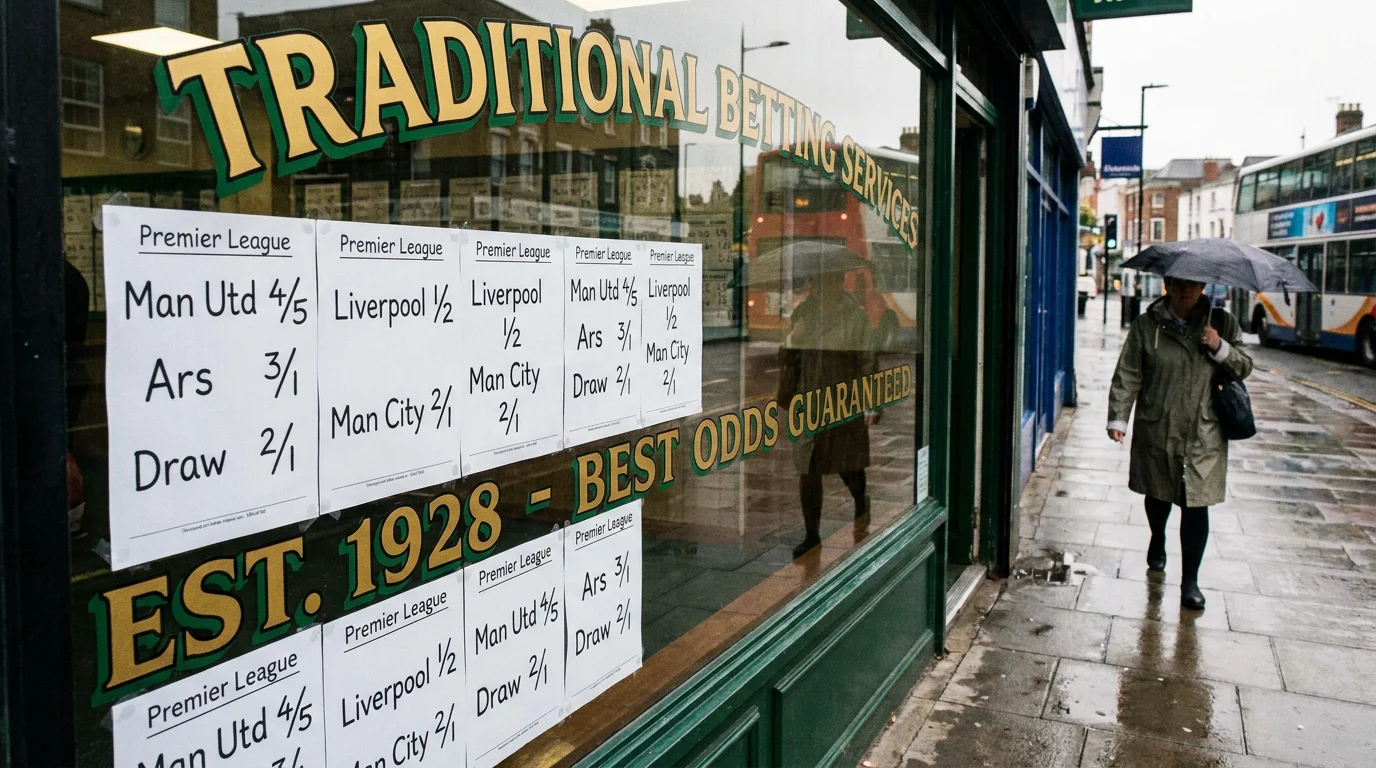
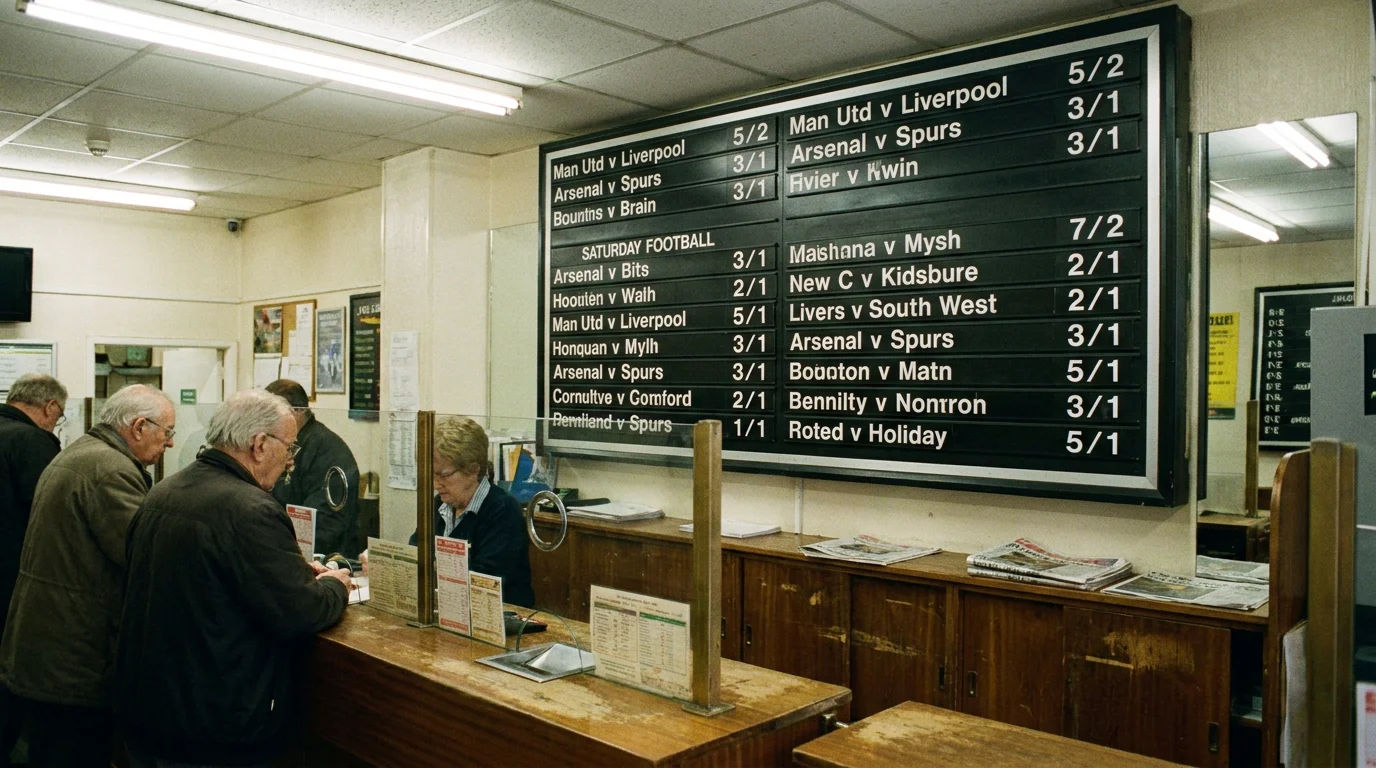
Walk into any bookmaker’s shop on a British high street — there are still 5,669 of them across the country — and the odds board will show fractional odds. It’s the format most UK bettors grew up with, the one that appears on racing pages and in pre-match TV graphics. And yet, for something so embedded in British betting culture, it confuses an astonishing number of people.
Fractional odds express your net profit relative to your stake. At 5/1 (spoken as “five to one”), you win £5 for every £1 you stake, plus your original stake back. A £10 bet at 5/1 returns £60 total: £50 profit plus your £10 stake. At 2/1, a £10 bet returns £30. At 1/2 (an “odds-on” price), a £10 bet returns £15 — just £5 profit on top of your tenner.
The left number is what you win. The right number is what you risk. That’s the core mechanic, and once you internalise it, fractional odds become intuitive. But they get awkward at unusual prices. What does 11/8 mean in practical terms? A £8 bet returns £19 (£11 profit plus £8 stake). It works, but it’s not immediately intuitive the way decimal pricing is. Fractions like 11/10, 6/5, 13/8, and 100/30 all describe precise prices, but they require mental arithmetic that many bettors shortcut or skip.
The larger the left number relative to the right, the bigger the payout and the less likely the bookmaker considers the outcome. A team priced at 14/1 is a long shot. A team at 4/9 is a heavy favourite — you’d need to stake £9 just to win £4 in profit. Where this matters for football is in understanding what the bookmaker is telling you about the match. A three-way market (home/draw/away) with prices of 4/5, 5/2, and 7/2 is saying: the home side is a clear favourite, the draw is possible but less likely, and the away side winning is the least probable outcome. Whether the bookmaker is right about that is a separate question entirely — and the question that matters most.
One detail worth noting: fractional odds always show net profit. If someone describes odds as “evens,” that’s 1/1 — you win £1 for every £1 staked. “Odds against” means the left number exceeds the right (you stand to win more than you stake). “Odds on” means the opposite. These terms come up constantly in UK football coverage, and they’re assumed knowledge in any betting conversation.
Decimal Odds: The European Format
I switched to decimal odds about five years ago and never looked back. Not because fractional odds are wrong, but because decimals make one critical calculation effortless: your total return. Decimal odds represent the total payout per unit staked, including the stake itself. At decimal odds of 3.50, a £10 bet returns £35 total. At 1.80, a £10 bet returns £18. At 6.00, a £10 bet returns £60. Multiply stake by odds, and you’re done.
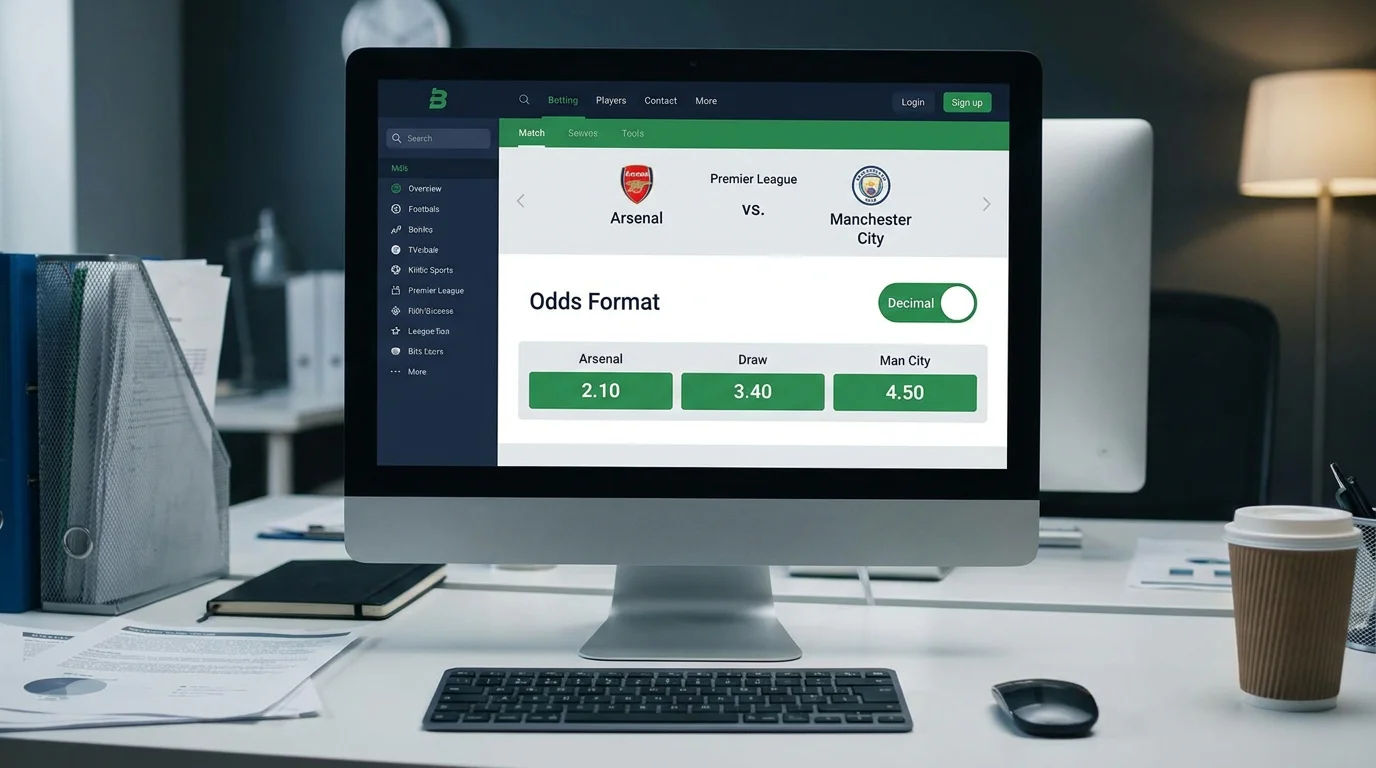
This is the standard format across European betting exchanges, and most UK bookmakers now let you toggle between fractional and decimal in your account settings. I recommend switching to decimal for one reason above all others: it makes comparing prices across bookmakers instant. Is 2.10 better than 2.05? Obviously. Is 11/10 better than 21/20? Same comparison, but now you have to convert both to a common base before you can tell. When you’re line shopping across five or six operators before kick-off, that friction matters.
Decimal odds also make implied probability calculations trivial, which I’ll get into shortly. For now, the key relationship to understand: decimal odds always include your stake. So 2.00 in decimal is the same as evens (1/1) in fractional — you double your money. Anything below 2.00 is odds-on. Anything above 2.00 is odds-against. The higher the decimal number, the less likely the bookmaker considers the outcome.
One area where decimals shine is in accumulator calculations. To find the combined odds of a four-fold acca, you multiply the four decimal prices together. At fractional odds, you’d need to convert each leg to a multiplier first, which is essentially converting to decimals anyway. If you bet on football with any regularity, decimal odds save you time, reduce errors, and make the maths transparent.
Converting Between Formats: A Step-by-Step Method
The conversion between fractional and decimal is simple once you see the pattern, but I’ve watched experienced bettors fumble it under pressure — particularly when they’re trying to compare a price from a high-street bookie’s window with an exchange price on their phone.
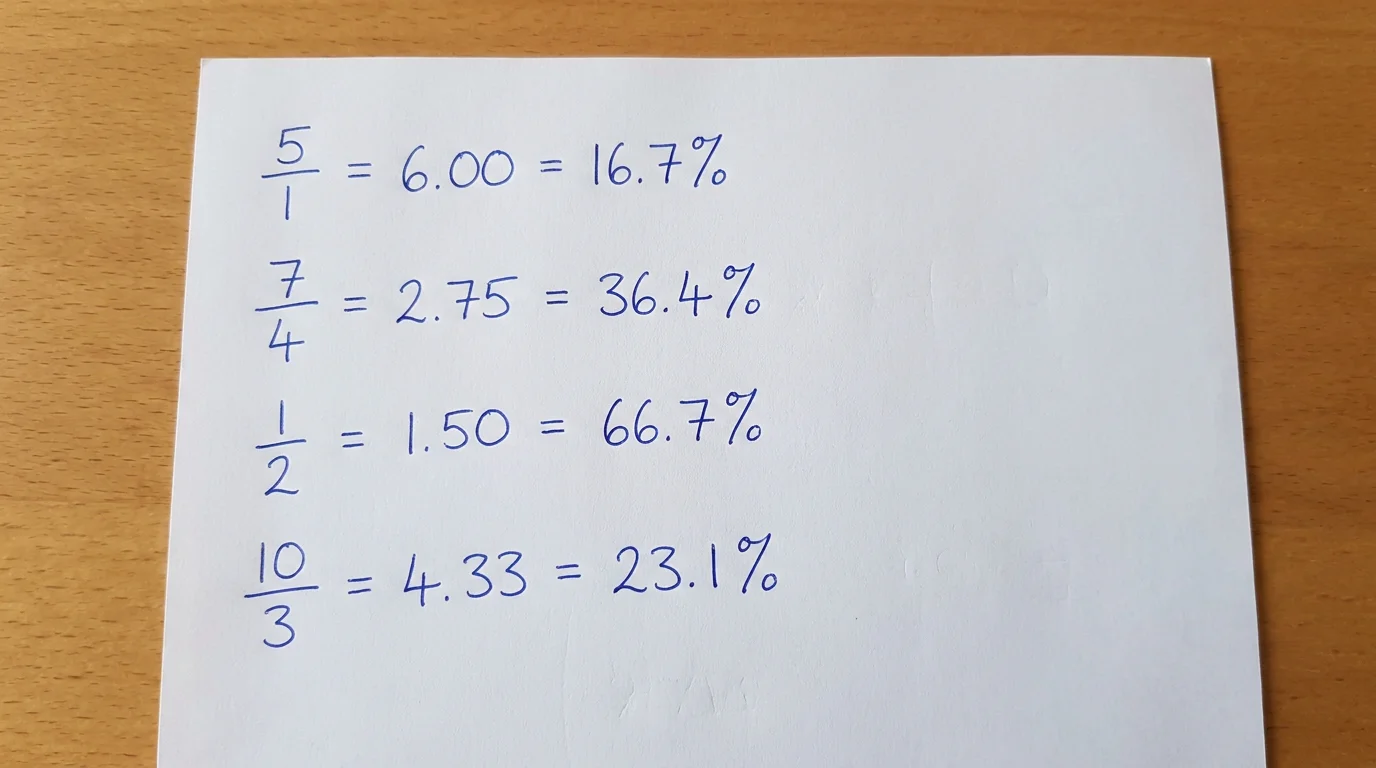
To convert fractional to decimal: divide the left number by the right number, then add 1. So 5/1 becomes (5 / 1) + 1 = 6.00. The fraction 7/4 becomes (7 / 4) + 1 = 2.75. And 4/9, that odds-on favourite, becomes (4 / 9) + 1 = 1.44. The “+1” accounts for your stake being included in the decimal format.
To go the other way, decimal to fractional: subtract 1 from the decimal, then express the result as a fraction. Decimal 3.00 becomes 3.00 – 1 = 2, which is 2/1. Decimal 1.80 becomes 0.80, which is 4/5. Decimal 2.375 becomes 1.375, which simplifies to 11/8. The trickier conversions involve decimals that don’t land on clean fractions — 2.15, for example, would be 23/20 in fractional form, which is why most UK bookmakers round to the nearest standard fraction.
There’s also the American format, used primarily in the US market. Positive American odds (like +250) show the profit on a $100 stake. Negative odds (like -150) show how much you need to stake to win $100. With the 2026 World Cup being hosted in the United States, Canada, and Mexico, you’ll encounter American odds more frequently if you’re reading US-based analysis. The conversion: for positive American odds, divide by 100 and add 1 to get decimal. So +250 becomes (250/100) + 1 = 3.50. For negative, divide 100 by the absolute value and add 1. So -150 becomes (100/150) + 1 = 1.67.
The format doesn’t change the bet. It only changes how the information is presented. What matters is that you can move fluently between formats so that no price, on any platform, is opaque to you. The bookmaker’s edge starts where your understanding of the numbers ends.
Implied Probability and Why It Matters
Here’s where odds stop being a payout table and start being a tool. Every set of odds implies a probability — the bookmaker’s assessment (before margin) of how likely that outcome is. Understanding implied probability is the single most important skill in football betting, because it’s the bridge between “what do these odds pay?” and “is this bet worth taking?”
The formula is clean: Implied Probability = 1 / Decimal Odds. At odds of 2.00, the implied probability is 1 / 2.00 = 0.50, or 50%. At 4.00, it’s 25%. At 1.50, it’s 66.7%. The lower the odds, the higher the implied probability — the bookmaker considers the outcome more likely.
In fractional terms: Implied Probability = Right Number / (Left Number + Right Number). So 3/1 gives you 1 / (3 + 1) = 25%. And 4/6 gives you 6 / (4 + 6) = 60%.
Why does this matter? Because once you convert odds into probabilities, you can compare them to your own assessment. Suppose a team is priced at 3.00 to win (implied probability 33.3%). You’ve done your analysis and you believe the team has a 40% chance of winning. That’s a gap of nearly seven percentage points in your favour. That gap is value. It doesn’t mean the team will win — it means the price is generous relative to the risk, and over a large sample of similar bets, you’ll come out ahead if your estimate is accurate.
Without implied probability, you’re making decisions in a fog. “3.00 seems like a good price” means nothing unless you can articulate what probability justifies that price and whether you believe the true probability is higher. This is the distinction between betting and guessing. Every serious bettor I know thinks in probabilities, not in odds. The odds are just the delivery mechanism — the probability underneath is what you’re actually assessing.
Start converting every price you see into an implied probability. Do it for a few weeks and it becomes automatic. You’ll stop seeing “5/2” and start seeing “28.6% chance, but I think it’s closer to 35%.” That shift in perception is worth more than any tipster service or betting system you’ll ever encounter.

The Bookmaker’s Margin: How Overround Works
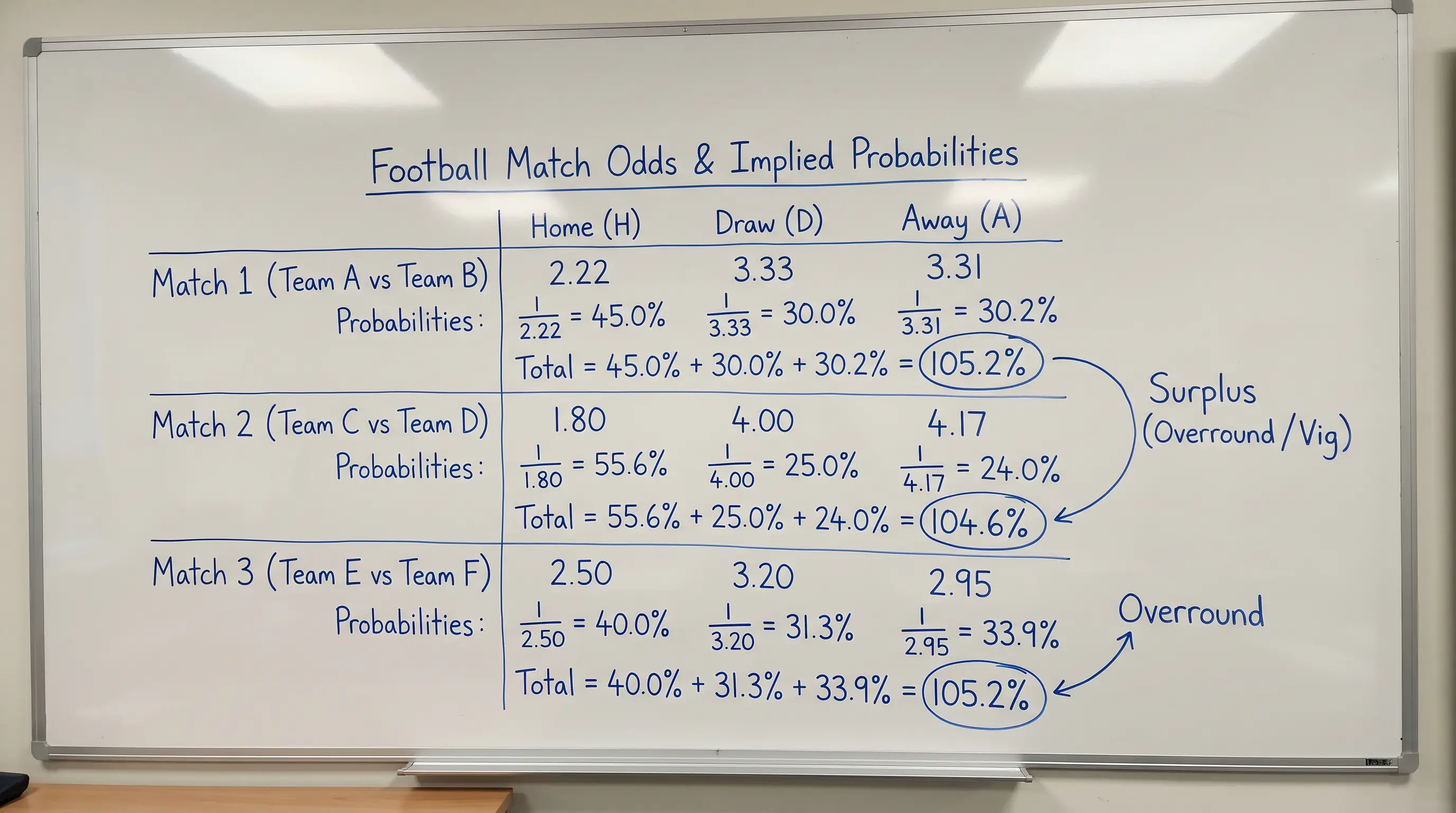
If you add up the implied probabilities of all outcomes in a football market, you’d expect them to total 100%. After all, one of the three results — home win, draw, away win — must happen. But they never add up to 100%. They always add up to more. That surplus is the overround, and it’s how bookmakers guarantee themselves a margin on every market they price.
Take a typical Premier League match. The implied probabilities might work out as: Home 45%, Draw 28%, Away 32%. That totals 105%. The extra 5% is the bookmaker’s overround — effectively a built-in house edge. It means that the odds offered on every outcome are slightly lower than they would be if the market were perfectly fair. You’re always paying a small premium for the privilege of placing the bet.
Flutter Entertainment, the parent company behind some of the UK’s largest operators, generated approximately $1.7 billion in sports betting revenue in the UK and Ireland in 2024 alone. That revenue comes, in part, from overround applied systematically across millions of markets. The total remote betting GGY of £2.6 billion tells the same story from the industry’s side: the margin works, and it works at scale.
Overround varies by market and by bookmaker. The 1X2 match result market for a big Premier League match might carry an overround of 103-106%. A correct score market on the same match could be 130-150%, because there are more outcomes and each one is priced with a wider margin. Goal scorer markets, bet builders, and specials tend to carry higher overrounds too — the more outcomes in a market, the more places the bookmaker can hide margin.
As a bettor, overround tells you the cost of participation. A market with 102% overround is giving you a much fairer deal than one at 115%. Learning to calculate overround quickly — just add up the implied probabilities of all outcomes — helps you identify which markets and which bookmakers offer the best structural value. If you’re serious about finding edges in football betting, reducing the overround you face on every bet is the first structural advantage available to you.
Why Odds Move and What It Tells You
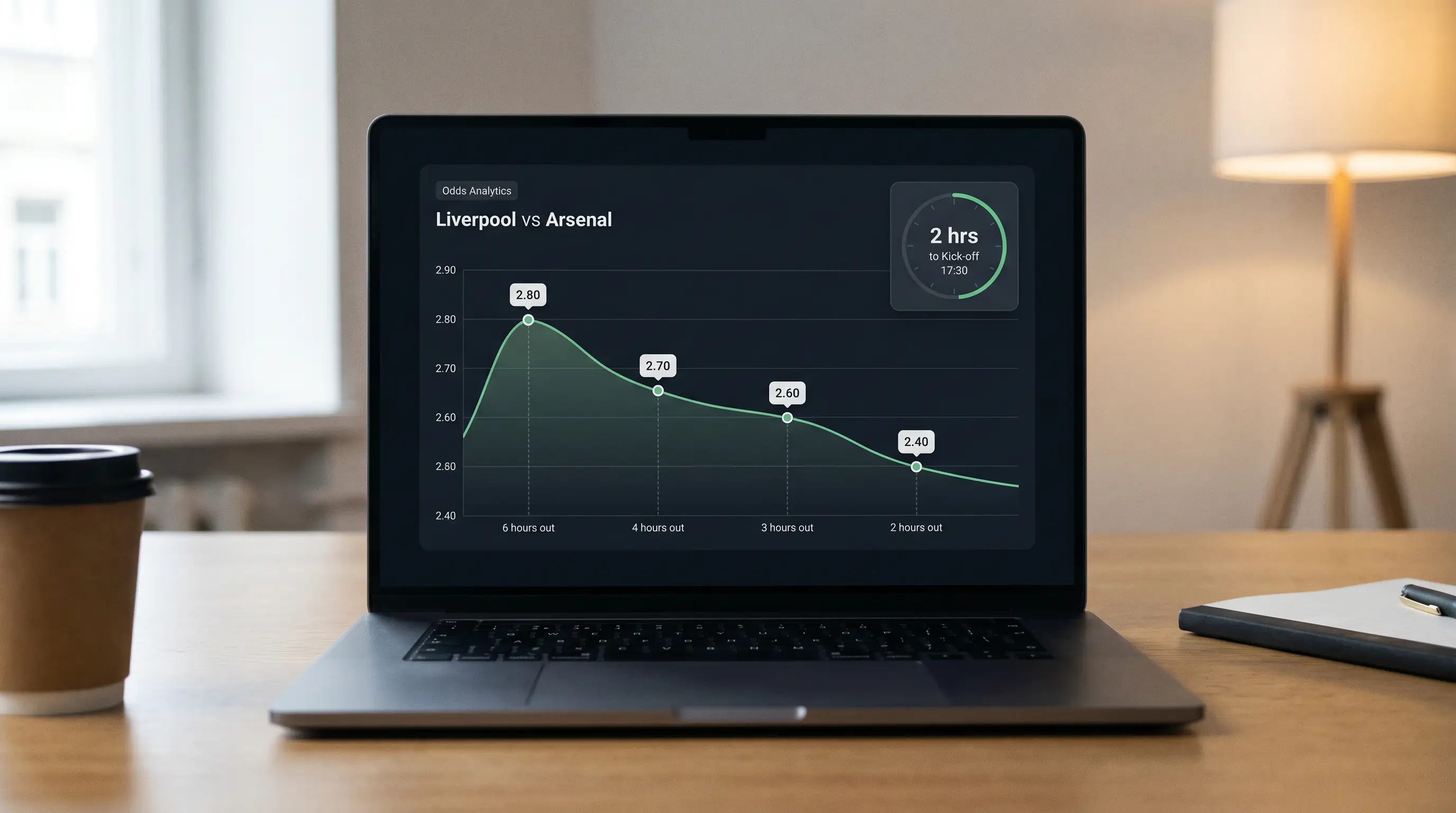
Last season I watched the odds on a mid-table Championship side drift from 2.40 to 3.10 in the space of two hours on a Saturday morning. No team news had broken. No injury update. The drift was driven entirely by money — sharp bettors had backed the opposition, and the bookmaker adjusted the price to rebalance their liability. By kick-off, the market had settled at 2.90, and the team in question lost 2-0. The money had been right.
Odds aren’t fixed. They move constantly between the moment a market opens and the moment the referee blows the whistle. Understanding why they move — and what those movements mean — gives you information that most recreational bettors ignore entirely.
The primary driver of odds movement is money. When a large volume of bets lands on one outcome, the bookmaker shortens that price (lowers the odds) and pushes the other outcomes out (raises their odds). This isn’t because the bookmaker has changed its opinion of the match — it’s risk management. The bookmaker wants roughly balanced exposure, so that whichever outcome occurs, they profit from the margin.
The second driver is information. Team news — a key striker ruled out, a goalkeeper passing a fitness test — can move a market significantly. Live football betting, where 6% of all UK adults participate, sees the most dramatic odds shifts because the information (goals, red cards, substitutions, injuries) arrives in real time. A goal changes the 1X2 market instantly. A red card at 0-0 can swing the prices by 30-40% in seconds.
What can you do with this? Two things. First, track opening prices. The opening line, set when the market first goes live (often 48-72 hours before kick-off for Premier League matches), reflects the bookmaker’s initial assessment before public money distorts it. If you consistently bet at opening prices and the closing price moves in your direction — the outcome you backed gets shorter — it’s a strong signal that your assessments are well-calibrated. This is called “beating the closing line,” and it’s the most reliable indicator of long-term profitability in sports betting.
Second, understand steam moves. A sudden, sharp movement across multiple bookmakers simultaneously (called a “steam move”) usually indicates that professional money has entered the market. Steam moves on team news are straightforward — the information is public. Steam moves without obvious cause deserve attention, because they often reflect information or analysis that the broader market hasn’t caught up to yet. I don’t follow steam moves blindly, but I always investigate them.
Grainne Hurst, CEO of the Betting and Gaming Council, has noted that betting is “a genuinely enjoyable experience for 22 million people every month in the UK.” For the overwhelming majority of those 22 million, odds are just a number that determines their payout. For anyone who wants to bet with an edge, odds are the primary source of information — and movement in those odds is a conversation between the market and reality that most bettors never bother to listen to.
Reading Odds Across Multiple Bookmakers
There are 8,148 licensed gambling premises in the UK and a far larger number of licensed online operators, each setting their own prices for every football match on their platform. Those prices diverge. Not by huge amounts on headline markets, but by enough to matter — and in less liquid markets, the differences can be substantial.
Reading odds across multiple bookmakers serves two purposes. The obvious one is finding the best price for the bet you want to place. A consistent habit of taking 2.10 instead of 2.00 on the same outcome doesn’t sound dramatic, but over a season of 200 bets it shifts your expected return by several percentage points. That’s the difference between a losing record and a breakeven one for many bettors.
The less obvious purpose is informational. When one bookmaker prices a team at 2.80 and everyone else has them at 2.50, something is going on. Either that bookmaker has taken heavy action on the other side and pushed the price out, or their model disagrees with the consensus. In both cases, the divergence tells you something. Sometimes it’s noise. Sometimes it’s a signal that one operator sees the match differently, and you can assess which view is more compelling.
Odds comparison tools aggregate prices across dozens of bookmakers and let you sort by market. They’re useful for speed, but I prefer to check three or four operators manually for the matches I’ve analysed, because the manual process teaches me each bookmaker’s tendencies over time. One operator might consistently offer the best prices on Championship Over/Under markets. Another might be sharper on Premier League match odds but looser on goal scorer props. Knowing these patterns lets you go straight to the best source without scanning every operator every time.
The Numbers Tell You Everything — If You Learn to Listen
Football betting odds are not decoration. They’re a compressed statement about probability, risk, and margin, and every bettor who takes this seriously needs to be fluent in reading them. The format is just packaging — whether you see 7/2, 4.50, or +350, the information underneath is identical. Learn to convert instantly, think in implied probabilities rather than payouts, calculate overround as second nature, and watch how prices move before kick-off. The bookmaker’s price isn’t your enemy — it’s your primary source of information. Understanding it is the foundation everything else in football betting is built on.
FAQ
What does 5/1 mean in football betting?
At 5/1, you win five pounds for every one pound you stake, plus your original stake back. A ten-pound bet at 5/1 returns sixty pounds total: fifty pounds profit plus your ten-pound stake. In decimal format, 5/1 is the same as 6.00. The implied probability is 16.7%, meaning the bookmaker considers this outcome relatively unlikely.
Why do odds change before kick-off?
Odds move for two main reasons: money and information. When a large volume of bets lands on one outcome, the bookmaker adjusts the price to manage their risk exposure. When new information emerges — such as a key player being ruled out through injury — the bookmaker reprices the market to reflect the changed circumstances. Sharp bettors track these movements because they reveal what the market collectively believes about the match.
How do I calculate my potential winnings from fractional odds?
Multiply your stake by the left number of the fraction, then divide by the right number. At 7/2, a ten-pound stake gives you: 10 x 7 / 2 = 35 pounds profit, plus your original ten-pound stake returned for a total of 45 pounds. For decimal odds, simply multiply your stake by the decimal number to get the total return including your stake.
What is a bookmaker’s overround and how does it affect my bet?
The overround is the bookmaker’s built-in margin. If you add up the implied probabilities of all outcomes in a market, they will total more than 100%. That surplus is the overround. A typical Premier League match result market might have an overround of 103-106%, meaning the odds on every outcome are slightly lower than they would be in a perfectly fair market. Higher overround means worse value for the bettor. Markets with fewer outcomes, like match result, generally have lower overround than markets with many outcomes, like correct score.
