
 Available in US
Content

Football Is the Gateway to Gambling for Most UK Young People
A friend’s teenage son asked me to explain accumulators after seeing them discussed in a group chat. He was fifteen. Nobody in the chat was old enough to legally open a betting account, but several of them were placing bets through older siblings, social media links, and offshore apps that did not verify age. I explained how accumulators work, then spent twenty minutes explaining why the group chat tips were almost certainly losing money. I do not know which part of the conversation he remembered.
Thirty percent of UK 11-17 year olds have gambled with their own money in the past twelve months. Nearly half — 49% — see gambling advertisements on social media every week. Football is the sport most closely associated with betting in the UK, and the overlap between young people’s passion for football and their exposure to gambling products creates a risk that the numbers make uncomfortably clear.
The Latest Data: What the Gambling Commission Survey Shows
The Gambling Commission’s Young People and Gambling 2025 survey provides the most comprehensive picture. Among 11-17 year olds, 30% had gambled with their own money in the past year. The figure has been broadly stable for several years, suggesting that existing interventions are containing but not reducing youth gambling participation.
Of those who gambled, 1.2% scored 4 or above on the DSM-IV-MR-J screen — the youth equivalent of the adult PGSI — indicating problem gambling behaviour. That 1.2% has not changed since 2024. Among adults, the picture is worse for young people: 5.3% of 18-24 year olds score 8 or above on the adult PGSI, the highest problem gambling rate of any age group. The transition from adolescent gambling to adult problem gambling is not inevitable, but the data shows that early exposure correlates with elevated risk.
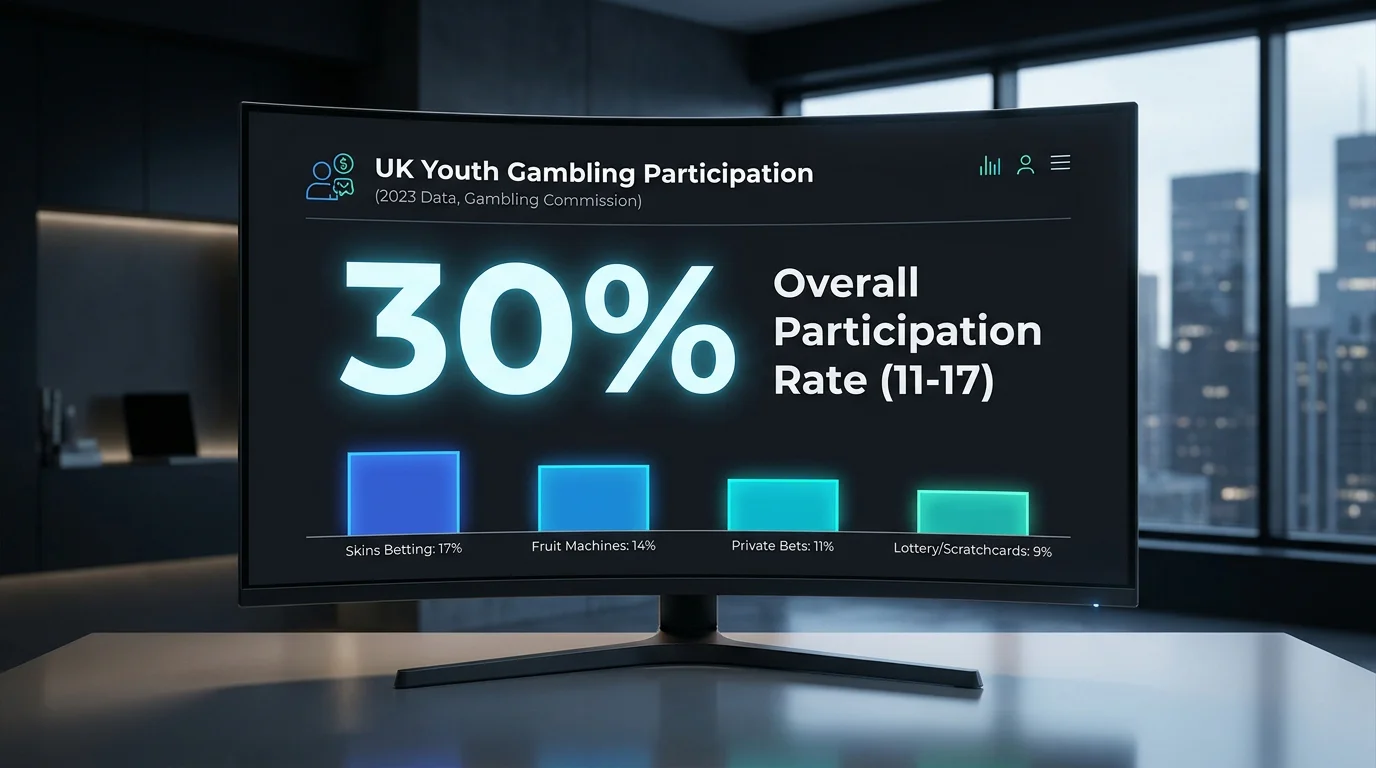
The types of gambling that young people engage in have shifted. Traditional fruit machines and scratch cards are declining. Online betting, social media-facilitated gambling, and in-game purchases with gambling-like mechanics are increasing. Football is the thread that connects many of these activities — whether it is a bet on a Premier League match, a social media prediction game, or a FIFA Ultimate Team pack opening that mimics the dopamine loop of a slot machine.
Social Media, Family Influence, and Advertising Exposure
The 49% of 11-17 year olds who see gambling ads on social media weekly are not seeking out gambling content. The ads appear in their feeds because the platforms’ algorithms identify them as football fans. A teenager who follows Premier League accounts, watches match highlights, and engages with football content is algorithmically similar to an adult bettor — and the ad targeting does not distinguish between them with sufficient precision.

Family influence is the other major channel. Twenty-nine percent of young people in the 2025 survey reported seeing a family member gamble — up from 26% in 2024. When a parent places bets on Saturday afternoon football with their phone visible, the behaviour is normalised. The child sees betting as part of watching football, not as a separate activity with its own risks. I have seen this dynamic in my own extended family: a cousin’s son started asking about odds and “value” at thirteen, having absorbed the vocabulary from his father’s Saturday routine.

A cross-party group of 19 UK MPs has noted that growing numbers of people are choosing to bet illegally rather than engage with a regulated market they find intrusive. Among young people, the dynamic is different but related: around 420,000 British school-age children are estimated to be gambling on unregulated platforms via social media, VPNs, and cryptocurrency wallets. These platforms have no age verification, no deposit limits, and no self-exclusion. A fifteen-year-old with a cryptocurrency wallet and a VPN can access offshore betting sites with no friction whatsoever.

420,000 School-Age Users on Unregulated Platforms
The 420,000 figure comes from industry analysis cross-referencing Gambling Commission enforcement data with platform usage estimates. It is a modelled number, not a census, and the true figure could be higher or lower. What is not in dispute is the direction: young people’s access to unregulated gambling is increasing, driven by technology that evolves faster than enforcement can respond.
One in five young adults aged 18-24 has used an unlicensed channel for betting. The behaviour often starts before they turn eighteen — using an older sibling’s account, accessing an offshore site via a friend’s link, or participating in social media betting pools where money changes hands through payment apps. By the time they are old enough to open a legal account, the habit of gambling without regulatory safeguards is already established.
The Gambling Commission’s enforcement efforts are substantial — 741 cease-and-desist orders and 397,527 URLs reported to search engines in 2025-26 alone — but they are designed to disrupt operators, not to reach individual young users. A teenager who accesses an unlicensed site through a Telegram group link is invisible to the Commission’s enforcement tools. The site may be shut down within weeks, but another will replace it, shared through the same social channels.
What Parents and Guardians Can Do
Awareness is the starting point. If your child is a football fan with a smartphone, they are being exposed to gambling content — through ads, through peers, and through the normalisation of betting in football culture. Pretending otherwise is not protective. Having a conversation about how betting works, how the bookmaker’s margin means most bettors lose, and what problem gambling looks like is more effective than attempting to block all exposure.
Practical steps include checking app installations on your child’s devices for betting apps or offshore sites, monitoring payment app transactions for gambling-related transfers, and setting content filters that block known gambling domains. Gamban — a software tool that blocks gambling sites at the device level — can be installed on family devices and is more comprehensive than most browser-based filters.

Deposit limits and spending alerts on payment apps provide a further layer of visibility. If your child has access to a prepaid card or a bank account, setting up transaction notifications means you see gambling-related spending in real time rather than discovering it weeks later.
The most important step, though, is modelling. If you bet on football yourself, your behaviour sets the template for your child’s future relationship with gambling. Betting within a structured framework — fixed stakes, defined bankroll, deposit limits, and transparent record-keeping — communicates that gambling is an activity with boundaries. Betting impulsively, chasing losses, and treating it as a source of excitement rather than a calculated risk communicates the opposite. For a data-driven overview of the tools and support available to anyone whose gambling has moved beyond recreation, the responsible gambling guide covers deposit limits, self-exclusion, and where to find professional help.

At what age can someone legally bet on football in the UK?
The legal minimum age for all forms of gambling in the UK — including online football betting, betting shops, and casinos — is 18. There are no exceptions for football betting. Anyone under 18 who places a bet is doing so illegally, and operators are required to verify the age of every customer before allowing them to gamble. Providing a false date of birth to open a betting account is a violation of the operator’s terms and may constitute fraud.
How widespread is underage gambling on football in the UK?
The Gambling Commission’s 2025 survey found that 30% of 11-17 year olds in the UK had gambled with their own money in the past 12 months, though this includes all forms of gambling, not just football betting. An estimated 420,000 school-age children access unregulated gambling platforms, many of which offer football betting. The 1.2% problem gambling rate among this age group has remained stable but the channels through which young people access gambling are shifting towards online and social media-facilitated platforms.
